



For those who don’t know, FOCUS is the foundation of all of my coaching and training; business and personal. I’ve written articles about it, spoke in front of large crowds about it, and spoken about it on podcasts… our focus determines our experiences and outcomes.
In 2026, 90% of the world is in a focus deficit. Everything we do from scrolling, reading, watching tv to working is designed to steal our focus, which is finite.
When we wake up in the morning, we have a “full-tank” of energy (hopefully) that we that we start to burn throughout the day.
MOST peole are focused on doomscrolling, politics, news, insecurities, the past, etc.
And, for us entrepreneurs, solopreneurs, founders and leaders… that is a recipe for struggle and failure.
Building, running and scaling a business requires 100% focus… ON THE RIGHT THINGS.
And, once we channel that focus, THEN we need to focus on building efficient systems.
So, I brought in Claudia Faith, who is one of the most efficient focused creators and entrepreneurs I’ve ever met in my life, to talk about efficient focus as a creator and solopreneur.
If you don’t know Claudia, she writes Wander Wealth which is one of the best communities focused on Substack and writing. Be sure to check it out.
Here she is to break it all down in a digestible format so you can start to improve your business and Substack focus IMMEDIATELY.
Pay attention!
Running a one-person business taught me something most leadership books miss: you can’t outwork a broken strategy.
You’ve seen it. The team putting in the hours, hitting every metric they’re supposed to hit, doing exactly what worked last quarter. And the results still flatten. More effort, same outcome.
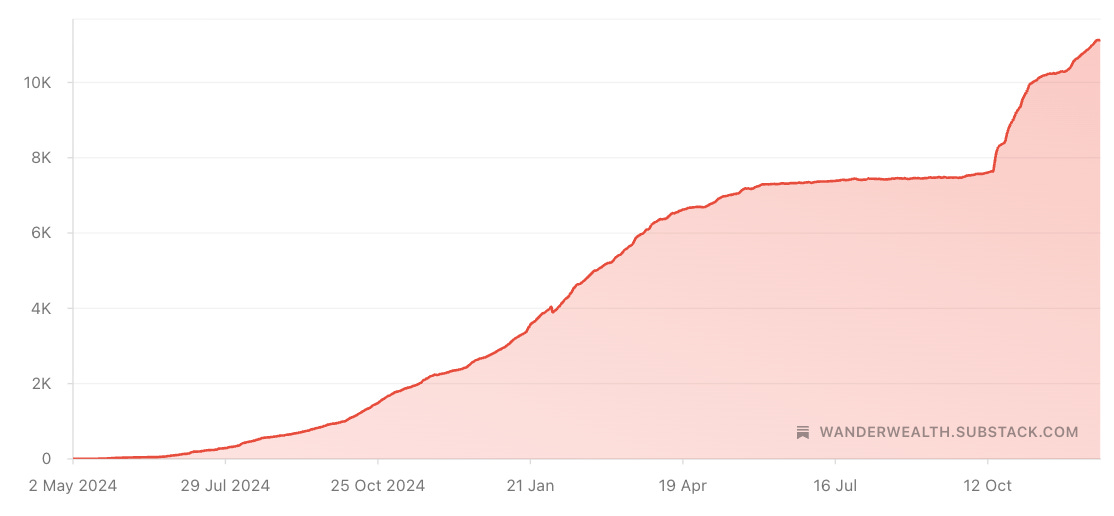
That’s where I found myself mid-2025. Consistent output. Solid systems. Showing up daily. And growth that had completely stalled.
So I did what any good leader should do when effort stops converting to results: I questioned the playbook.
I tore apart my approach. Tested new formats. Followed the data instead of my assumptions. Killed tactics I was emotionally attached to.
Three months later, I’d broken through the plateau and added 3,000 new subscribers. Not from working more hours. From working on the right things.
Here’s what that experience taught me about focus, systems, and knowing when to pivot.
Systems Create Capacity. They Don’t Replace Judgment.
I’m a systems person. Every project I run has its own setup: templates, voice guidelines, workflows, standard operating procedures. When I sit down to work, I don’t start from zero. The system removes friction so I can focus on what actually matters.
Part of that system is AI. I use Claude Projects as a second brain. Each project holds my voice guidelines, past work that performed well, templates, even brand details. When I open it, the AI already knows my context. I’m not explaining from scratch or hunting for that one document I wrote six months ago.
It’s not about AI doing the work. It’s about removing the friction that kills momentum before the real work begins.
This is true for any team. Good systems free up mental bandwidth. They eliminate decision fatigue. They let your people spend energy on high-value work instead of reinventing the wheel every Tuesday.
But here’s the trap: systems can become autopilot. And autopilot is dangerous when the landscape changes.
My systems kept me consistent through the plateau. They also kept me doing the same thing for three months while results flatlined. The system was working perfectly. The strategy underneath it had expired.
The lesson for leaders: build systems that create capacity, but never outsource your judgment to them. Someone has to keep asking whether the machine is pointed in the right direction.
Schedule Outcomes, Not Activity
I don’t block time for “writing” or “strategy work.” I schedule specific deliverables.
Tuesday morning isn’t “work on content.” It’s “draft the hook and opening section for Thursday’s post.” Wednesday afternoon isn’t “planning.” It’s “analyze last week’s metrics and identify one thing to test.”
The difference sounds small. It changes everything.
Vague time blocks invite busywork. Specific deliverables create accountability. When the calendar says “write post,” there’s no ambiguity about what done looks like. I just do the thing.
This scales to teams. “Work on the Q1 plan” is an invitation for meetings about meetings. “Draft three strategic options with trade-offs by Thursday” is a deliverable.
Focused organizations don’t just protect time. They protect clarity about what that time should produce.
The Two Modes of Focus
Most productivity advice treats focus as one thing: eliminate distractions, do deep work, stay the course.
That’s half right.
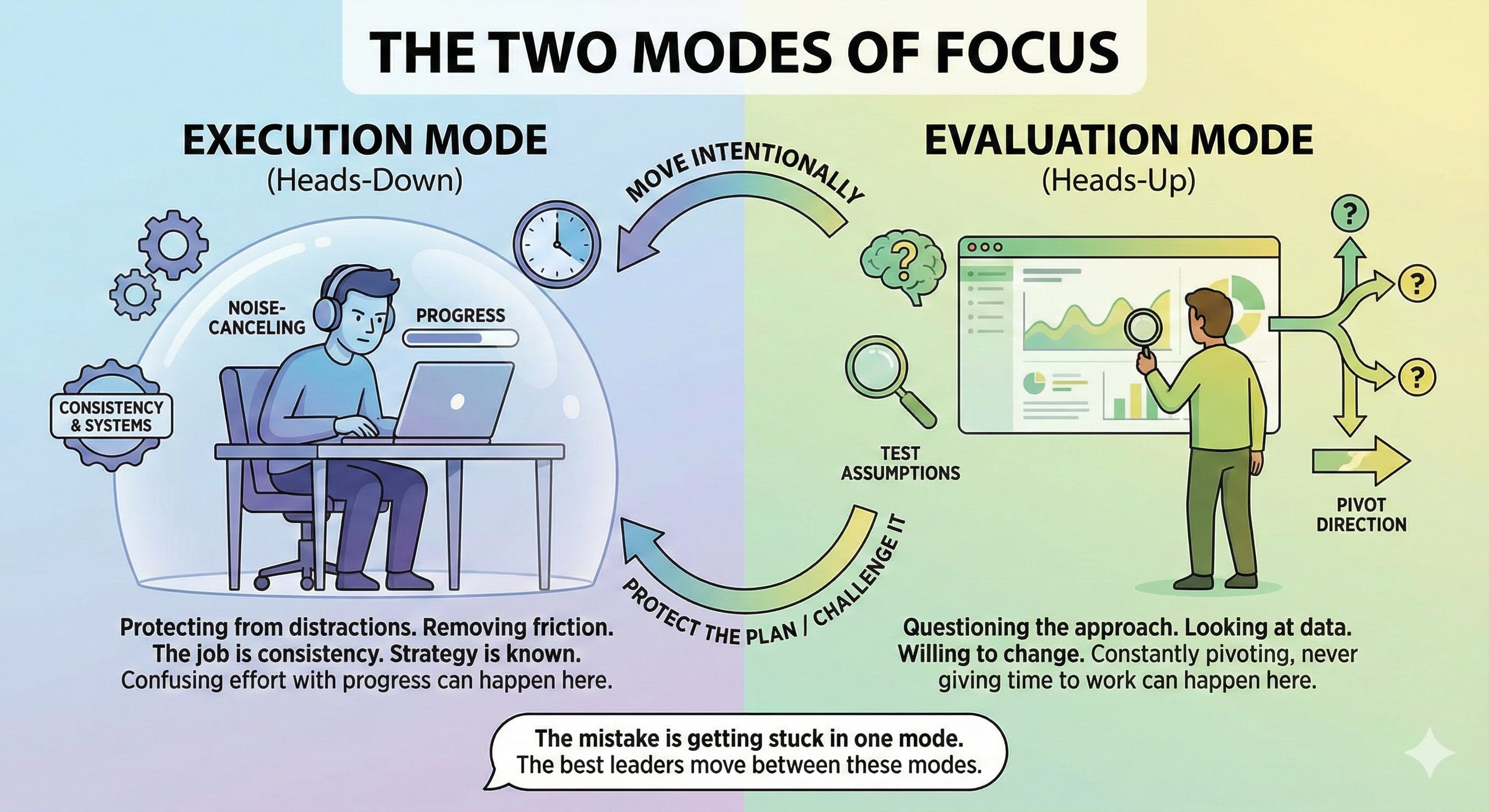
There are actually two modes, and leaders need both.
Execution focus is heads-down. You know the strategy works. The job is consistency, removing friction, protecting your team from distractions so they can deliver.
Evaluation focus is heads-up. You’re questioning whether the current approach still fits. You’re looking at data, testing assumptions, willing to change direction.
The mistake is getting stuck in one mode.
Too much execution focus and you grind on a broken strategy for months, confusing effort with progress. Too much evaluation focus and you’re constantly pivoting, never giving anything time to work.
My plateau lasted three months because I stayed in execution mode too long. The breakthrough came when I shifted to evaluation mode. Not panicking, but deliberately questioning what had stopped working.
The best leaders I’ve seen move between these modes intentionally. They know when to protect the plan and when to challenge it.
The Real Work
None of these tactics matter without one thing: clarity on what you’re building and why.
You can have the best systems, the most detailed calendar, the most optimized workflows. You can still fail because you abandon ship the moment results dip.
Focus isn’t about eliminating distraction. It’s about having such clear conviction in where you’re going that most distractions become irrelevant. And when something does need to change, you change it based on evidence, not anxiety.
That certainty doesn’t come from motivational speeches. It comes from building a track record of showing up, adjusting when needed, and watching the results compound over time.
The tactical stuff (the systems, the time blocks, the routines) reduces friction. The real work is building conviction that survives the plateaus.
Start Here
Pick one recurring decision that drains your energy or your team’s energy. The process you rethink every time. The format you reinvent every quarter. The question that keeps coming back without a clear answer.
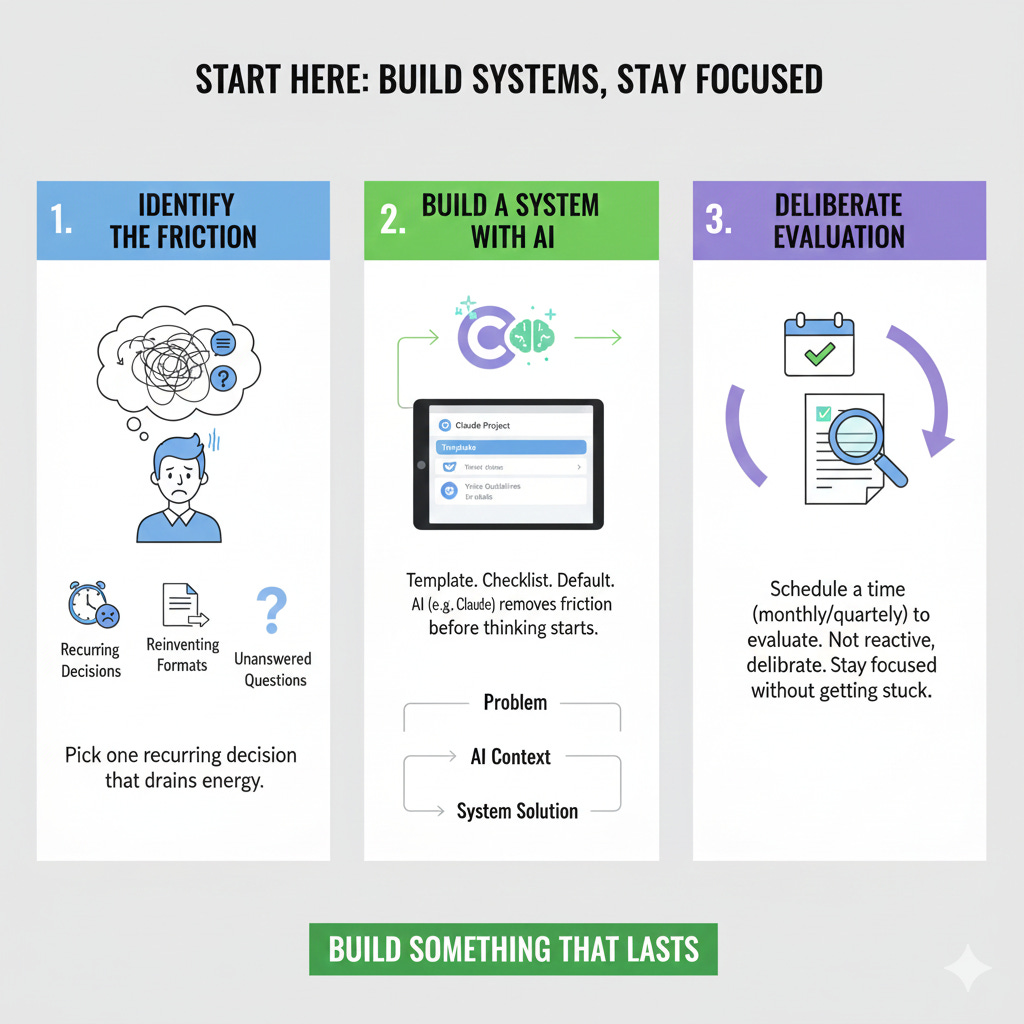
Build a system for that one thing. A template. A checklist. A default. Something that means you never start from zero again.
AI can accelerate this. A Claude Project or custom GPT loaded with your context, your templates, your preferences. The tool already knows how your team works. Not AI that replaces thinking, but AI that removes the friction before the thinking starts.
Then schedule a time (monthly, quarterly, whatever fits) to evaluate whether that system still serves you. Not constantly. Not reactively. Deliberately.
That’s how you stay focused without getting stuck. That’s how you build something that lasts.

Claudia Faith runs Wander Wealth, a newsletter for creators, and Level Up with AI, helping people use AI as a creative partner. She grew her publication to over 12,000 subscribers in 19 months while running a startup - by building systems boring enough to run themselves, and breaking them when they stopped working.
P.s.: If you’re figuring out how to bring AI into your team’s workflow without the chaos, I co-founded Cozora for exactly this. Live sessions every Thursday with experts who’ve actually implemented this stuff. Practical AI systems you can use Monday morning.
This is such a masterful piece. For me, my biggest takeaway is to not start from zero everyday. That is the advantage of having Ai on our side.
Ai doesn’t just write witty content, it reduces friction, finds and fixes bottlenecks and helps us create and implement efficient systems.
And, for the next-level… you can use it to spot flaws and shortcomings before they destroy your business and/or your life. That’s real emotional maturity. The best leaders and business owners embrace negative feedback.
PS. If you’re struggling to find your balance and optimize your business and life, there are two ways I can help:
Take the science based stress quiz to see if you’re in alignment (HERE)
Let’s connect on Linkedin along with 200,000 other Elite Leaders (HERE)
I know what it’s like to suffer and struggle in silence. I’ve built an amazing life after many years of addiction and struggle. And, I’ve helped thousands to the same thing. Let’s connect and find out how.

wow -> "So, I brought in Claudia Faith, who is one of the most efficient focused creators and entrepreneurs I’ve ever met in my life, to talk about efficient focus as a creator and solopreneur." this made me blush 😌 thank you so much, Dennis!
Dennis, so wonderful that you collaborated with Claudia Faith on this article! Love this piece. My biggest takeaway: stop starting from zero. AI gives us clarity, not shortcuts.