


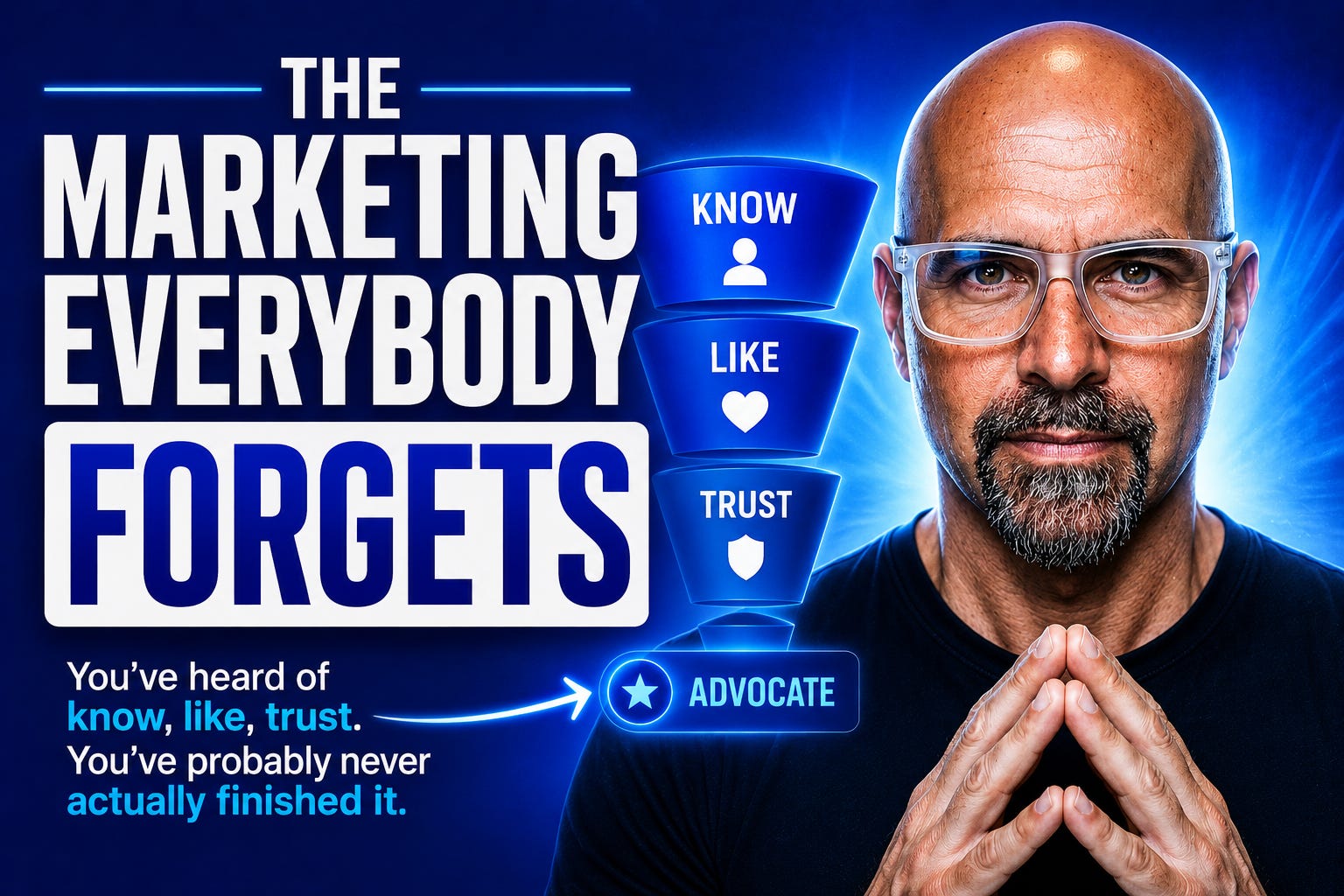
Most marketing failures are not creative failures.
They are sequence failures.
The offer is good. The product works. The founder is capable. But somewhere in the chain between a stranger discovering you and that stranger becoming a paying client, something breaks - and because the break is invisible, it gets diagnosed as the wrong problem. The copy needs work. The ads need better targeting. The funnel needs another step.
The machine was never broken. It was just built out of order.
Know, like, trust is the oldest framework in marketing. Older than digital. Older than advertising as an industry. It predates the internet by decades and the printing press by centuries. And it still runs every purchase decision made by every human being on earth, without exception - including the ones made by people who have never heard the phrase.
The reason most founders break it is not ignorance. It is impatience. And fixing it does not require starting over. It requires understanding exactly where the sequence snapped and why.
The Framework Everyone Knows and Almost Nobody Completes
“Get closer than ever to your customers. So close that you tell them what they need well before they realize it themselves.”
Steve Jobs
Here is the framework in its simplest form.
A stranger must first know you exist. Then they must like what they find when they look. Then they must trust you enough to act. In that order. Without exception.
The sequence is not interchangeable. Trust cannot precede like. Like cannot precede know. You cannot convince someone to trust a person they have not yet decided they like. You cannot make someone like a person they do not yet know exists.
This sounds obvious. And it is - until you look at how most marketing budgets are actually allocated.
Most companies spend the majority of their resources at the trust layer. Sales pages. Conversion optimization. Retargeting. Testimonials. Case studies. Pricing psychology. All of it is trust-layer work - attempts to move someone from consideration to commitment.
That work is not wasted. But it is wildly over-indexed relative to the layers above it.
Because the trust layer only works on people who already like you. And the like layer only works on people who already know you. If the top of the machine is broken or thin, all the optimization at the bottom is running on an empty pipeline.
This is where the sequence fails. Not at the bottom - at the top.
Know: The Layer Everyone Underbuilds
“The value of an idea lies in the using of it.”
Thomas Edison
Know is not awareness. That distinction matters more than it sounds.
Awareness is passive. It means someone has technically encountered your name or logo. Know means something different - it means a person has received enough signal about who you are and what you stand for that they have formed a preliminary map of you in their mind. They know what you’re about. They know what you believe. They know, roughly, who you are for.
Awareness is a billboard. Know is a conversation they overheard and remembered.
Most founders build awareness. They run ads, get mentioned in publications, attend events, post company updates. The name circulates. But nothing accumulates. Because awareness without orientation is just noise - and a person who has seen your logo twelve times but still cannot articulate what makes you worth their attention is not someone who knows you. They are someone who has been exposed to you.
The know layer is built through what a person encounters when they look closer. Not your website’s homepage. Not your mission statement. The thinking behind the company - the documented perspective, the specific point of view, the evidence that a real mind is operating here with something worth understanding.
This is why founder visibility is not a vanity project. The founder’s public thinking is the primary mechanism through which a stranger moves from exposure to orientation. From “I’ve heard of them” to “I know what they’re about.”
When that mechanism is absent - when there is no human perspective to orient around - the know layer never closes. The stranger stays a stranger regardless of how many times they see the logo.
Like: The Layer Everyone Misreads
“People don’t buy what you do. They buy why you do it.”
Simon Sinek
Like is the most misunderstood layer in the framework.
Most founders interpret it as likability - warmth, personality, relatability, the social performance of being someone people want to be around. And so they either lean into it uncomfortably (forced personality, performative behind-the-scenes content, manufactured vulnerability) or they reject it entirely (”I’m building a serious business, not running for prom king”).
Both responses misread what like actually is in the context of a purchase decision.
Like, in the know-like-trust sequence, is not about personality. It is about alignment.
A potential buyer likes you when they believe that you see the world the way they see it - that your values, your priorities, your understanding of the problem they have are calibrated to theirs. It is not “I want to have a beer with this person.” It is “this person gets it.”
The like layer is built through specificity of perspective. Not warmth. Not humor. Not relatability. The feeling of being understood by someone who has thought carefully about the same things you have.
This is why generic content - content that tries to appeal to everyone - destroys the like layer even when it succeeds at the know layer. A person can know you exist, read your content regularly, and still not like you in the marketing sense - because everything you produce feels designed for a broad audience rather than for them.
The founders who build the like layer fastest are the ones willing to be specifically, unapologetically themselves - to take positions, to have a distinct lens, to address a particular kind of person rather than everyone. The narrowing that feels like losing reach is actually the mechanism of like-building.
You cannot be aligned with everyone. And trying to be is the surest way to be liked by no one.
Trust: The Layer Everyone Over-Invests In
“It takes 20 years to build a reputation and five minutes to ruin it.”
Warren Buffett
Trust is where the money changes hands. Which is why it receives the most attention, the most budget, and the most optimization.
And which is why it is the most over-invested layer in most marketing systems.
Trust does not need to be manufactured from scratch at the point of sale. If the know and like layers have done their work, trust is already substantially built before the buyer ever reaches your offer. The sale is the natural next step in a relationship that has been developing for weeks, months, or years - not a persuasion problem requiring an elaborate sequence of objection-handling and social proof.
When trust has to be constructed entirely at the conversion layer - through testimonials, guarantees, risk reversals, urgency mechanisms - it is because the layers above it failed to do their work. The buyer arrives at the offer as a stranger. And strangers require a great deal of convincing.
This is the fundamental economics of the machine. Every dollar spent building know and like compounds forward, reducing the cost of trust-conversion on every future buyer. Every dollar spent only at the trust layer is spent fresh each time - with no compounding, no accumulation, no permanent asset being built.
The founders with the lowest customer acquisition costs are almost never the ones with the best sales pages. They are the ones whose buyers arrive already knowing, already aligned, already 80% committed - because the machine above the sale has been running long enough and honestly enough that the sale itself is almost a formality.
Where Founders Break the Sequence (And How to Diagnose It)
The breaks are predictable. They fall in the same places almost every time.
The first break: building trust infrastructure before like infrastructure.
The founder invests in testimonials, case studies, and social proof before building any meaningful perspective in public. The result is a trust layer with nothing feeding it. The testimonials are genuine. The case studies are strong. But the person reading them arrived cold - no prior orientation, no sense of alignment, no reason to weight this particular proof over any other company’s equivalent proof. Conversion is low. The diagnosis is usually “we need better testimonials.” The actual problem is an empty like layer.
The second break: confusing awareness with know.
The founder runs awareness campaigns and measures reach, impressions, and brand recall. The numbers look healthy. The pipeline is thin. Because awareness without orientation does not move people down the sequence - it just exposes them to a name they have no context for. The fix is not more reach. It is more depth on every touchpoint - content that gives a stranger an actual map of who you are and what you believe, so that exposure becomes orientation.
The third break: building like through personality instead of perspective.
The founder shows up consistently, posts regularly, is visibly human and warm and relatable - and still doesn’t convert. Because the audience likes the person in a social sense without feeling the specific alignment that drives a purchase decision. The content entertains or inspires but does not demonstrate that this person deeply understands the specific problem the buyer has. Like in the marketing sense requires the buyer to feel: this person is for me. Personality builds an audience. Perspective builds buyers.
The fourth break: running the sequence out of order under pressure.
Revenue is tight. The founder skips straight to trust-layer activity - promotions, offers, urgency, direct asks - on an audience that has not moved through know and like. The result is either silence or a response that feels transactional and slightly off. Not because the offer is wrong. Because the relationship isn’t there yet. The fix is not a better offer. It is patience and a willingness to let the sequence run at its own pace.
The Machine Is Not Complicated. It Is Just Slow.
“Genius is one percent inspiration and ninety-nine percent perspiration.”
Thomas Edison
The reason founders break the sequence is almost never strategic. It is emotional.
The machine is slow. The know layer takes months to build. The like layer takes consistent, specific, honest output over time. Trust, built properly, is the accumulated result of both - and it arrives on the buyer’s schedule, not the founder’s.
Against a revenue target, against investor pressure, against the very human desire to see results from effort, the sequence feels unbearably gradual.
And so founders shortcut it. They go straight to the offer. They optimize the conversion layer. They run the trust machinery on cold audiences and wonder why the numbers don’t move.
The machine is not broken. It is just being asked to run backwards.
The founders who have figured this out have made a specific peace with the economics. They have accepted that the know and like layers are infrastructure - not immediately revenue-generating, not attributable in a clean line to any specific sale, but compounding underneath every sale they will ever make. They treat early content and visibility work the way an engineer treats a foundation: not glamorous, not fast, but the thing everything else stands on.
And they have found, consistently, that the machine - once properly sequenced and given enough time - runs almost automatically. Buyers come in already oriented. Sales conversations are shorter. Objections are fewer. Price resistance is lower. Referrals are organic.
Not because the marketing got cleverer. Because the sequence was finally allowed to run in the right direction.
The oldest framework in marketing still runs everything.
It ran everything before anyone named it. It will run everything long after the current generation of tactics is obsolete. Know, like, trust is not a funnel. It is a description of how human beings have always decided to extend confidence to a stranger.
You cannot hack it. You cannot reorder it. You cannot fund your way past it.
What you can do is build it correctly, let it run, and stop diagnosing conversion problems that are actually sequence problems.
The machine works.
The only question is whether you have built all of it - or just the part that feels urgent.
- Dennis
This is where I’ve had to learn the hard way.
Being good at the work doesn’t mean people understand why they should care right now.
You have to keep making the same truth easier to see, without getting bored of saying it before the market has even heard it.
So many businesses focus on selling before they've earned attention and trust. Great lesson.