


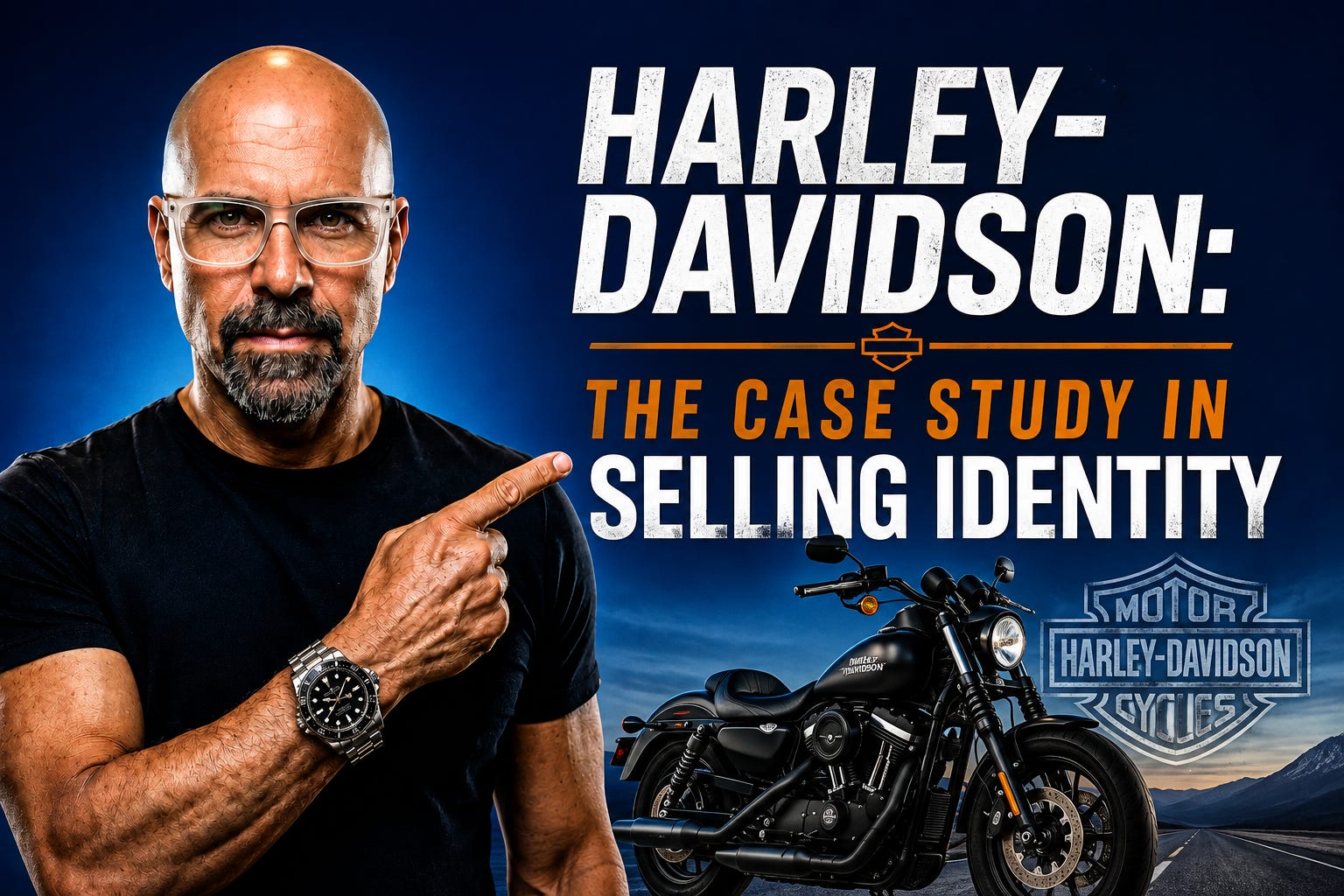
What Harley-Davidson Actually Sells
Harley-Davidson doesn’t sell motorcycles. On pure engineering specs, plenty of Japanese and European bikes outperform a Harley for less money.
Harley sells the identity of the rider. Freedom, rebellion, individualism, and belonging to something bigger than yourself, all delivered through a machine that looks and sounds unmistakably like nothing else on the road.
This is a different mechanism than Ferrari or Rolex. Ferrari and Rolex sell exclusion, being one of the few chosen. Harley sells inclusion into a tribe, and it’s just as powerful, arguably more durable, because it turns customers into evangelists instead of just owners.
People don’t just buy a Harley. They tattoo the logo onto their bodies. That’s not a metric any marketing department can manufacture with an ad budget. It has to be built structurally, over decades, and Harley is one of the clearest examples of exactly how that gets done.
Mechanism 1: Sell the Feeling, Not the Machine
Harley’s advertising rarely leads with horsepower or torque. It leads with the open road, the wind, the escape from routine, the sense that riding is an act of reclaiming your own life. The brand has anchored itself to freedom and individualism since its founding in Milwaukee in 1903, and it has never let go of that positioning, even as the product itself evolved dramatically across the decades.
That consistency matters more than the message itself. Any brand can claim to sell freedom. Harley has claimed it, unbroken, for over a century, which is what allows the claim to actually mean something instead of reading as a slogan.

Framework: The Feeling Behind the Feature
Write down every functional benefit of what you sell. Then, for each one, ask what emotional payoff that feature actually delivers. Horsepower becomes escape. A CRM becomes control. A meal kit becomes time back with your family.
Choose one core feeling and build every piece of messaging around it, for years, not for a single campaign. The discipline to repeat the same emotional promise long enough for it to become synonymous with your brand is rarer, and more valuable, than finding the promise in the first place.
Ask whether your current marketing is describing the product or describing the life the product makes possible. If it’s the former, you’re competing on specs. If it’s the latter, you’re competing on identity, and almost nobody can out-discount an identity.
Mechanism 2: Institutionalize the Community, Don’t Just Attract It
In 1983, Harley launched the Harley Owners Group, known as H.O.G., turning what had been an informal culture of riders into a formal, sponsored, global membership organization with local chapters, organized rides, and rallies. It’s often described as one of the first real brand communities ever built at scale, well before social media existed to make community building easy. Membership meant camaraderie and shared identity were now something the company actively organized and funded, rather than something that happened to occur around the product.
The distinction matters. A lot of brands have passionate customers. Very few brands build the actual infrastructure, local chapters, events, a formal membership structure, that lets those customers organize themselves and recruit others on the brand’s behalf.
Framework: Build the Chapter, Not Just the Fan Base
If people already gather informally around your brand, whether in a Facebook group, a subreddit, or just word of mouth, consider what it would look like to formalize that into something with a name, a structure, and a way to belong officially.
Give your community a reason to gather in person or in real time, not just to consume your content. Events, meetups, and shared rituals create loyalty that a newsletter never will.
Make joining the community feel like an upgrade in identity, not just an email signup. H.O.G. membership isn’t administrative, it’s a badge. Ask what the equivalent badge is for your business.

Mechanism 3: Own a Sensory Signature
Harley’s engine has a distinctive, rumbling exhaust note, often described as a “potato-potato” sound, that’s instantly recognizable even to people who know nothing about motorcycles. The sound is so central to the brand that Harley pursued a trademark on it in the 1990s, an attempt to legally claim ownership over how the product sounds. The application was eventually dropped after years of opposition from competitors, but the fact that Harley tried says everything about how seriously the company treats its sensory identity as a brand asset, not just an engineering byproduct.
Paired with the visual design language that’s remained consistent for decades, chrome, the silhouette, the styling cues, Harley has built a brand you could identify with your eyes closed. That’s an extraordinarily rare level of distinctiveness in any category.
Framework: Find Your “Potato-Potato”
Identify whether your brand has any sensory signature at all, a sound, a visual cue, a specific phrase, a color, a texture, that a customer could recognize without seeing your logo.
If you don’t have one, build one deliberately, and then repeat it without variation until it becomes inseparable from the brand. Consistency is what turns a design choice into a signature.
Protect it. Whether or not you can legally trademark a sound or a color, treat your sensory identity as seriously as you’d treat your logo. Small inconsistencies erode recognizability faster than most founders realize.
Mechanism 4: Let the Customer Finish the Product
Harley built a business around customization from the beginning, encouraging owners to modify, personalize, and build out their bikes so that no two Harleys on the road feel quite the same, even though they share a common platform. The company later formalized this into official product lines, the Icons Collection, for example, deliberately referencing earlier customization movements the brand itself helped inspire.
This does something psychologically that a finished, polished product can never do. A fully customized Harley isn’t just something the owner bought, it’s something the owner built. That participation converts a purchase into an extension of personal identity, which is a far stickier form of loyalty than satisfaction with a product feature.

Framework: Leave Room for the Customer to Finish It
Look for a point in your product or service where you can hand the customer a meaningful, visible choice, a way to personalize, configure, or make the outcome recognizably theirs.
The customization doesn’t need to be technically complex. It needs to be visible enough that the customer feels ownership over the result, not just the purchase.
Consider building an official channel, a gallery, a showcase, a feature, that lets customers display their personalized version publicly. Harley didn’t just allow customization, it eventually celebrated it as core brand content.
Mechanism 5: Extend the Identity to People Who’ll Never Own the Product
Harley sells jackets, boots, and gear that let people wear the brand’s identity without ever purchasing or riding a motorcycle. On paper, apparel is a small fraction of total revenue. In practice, it’s an enormous, continuously running billboard, because every piece of Harley clothing turns its wearer into an unpaid brand advocate walking around in public. Fashion, unlike a heavyweight motorcycle, is accessible to nearly anyone, which means the brand’s cultural footprint massively outsizes its actual customer base of riders.
This is a brand extension strategy that widens the identity’s reach without touching the exclusivity of the core product. Owning the bike still means something specific. Wearing the jacket means something adjacent, aspirational, and accessible.

Framework: Build the On-Ramp Product
Identify a lower cost, lower commitment version of your brand identity that someone can buy into before, or instead of, buying your core product.
Make sure the on-ramp product still visibly signals the same identity as the flagship offer, so it functions as advertising, not just as a separate revenue line.
Resist diluting the core offer to make the on-ramp cheaper. The gear works because it’s still unmistakably Harley. If the extension stops looking, sounding, or feeling like the flagship brand, it stops doing its job.
The System Underneath the Marketing
Formal community infrastructure. H.O.G. isn’t a marketing campaign, it’s an organizational structure with chapters, events, and a membership system that has to be operated and funded continuously. If community is core to your brand, budget and staff it like a real program, not a side project.
Dealer network as brand experience. Harley’s dealerships function as retail theater and entry points into the culture, not just points of sale, offering demos and a Riding Academy that lowers the barrier for new riders to join the tribe. Every physical or digital touchpoint your customer has with your business is either reinforcing the identity or quietly undermining it.
Design and quality governance. Harley went through a well documented quality crisis in the late 1970s and early 1980s that nearly ended the company, and recovered specifically by rebuilding manufacturing discipline and involving employees directly in quality improvement. A brand built on emotional identity can survive almost anything except a product that stops delivering on the functional promise underneath the story. The story buys patience. It doesn’t buy forever.
The Harley-Davidson Playbook, Condensed
Sell the emotional payoff behind the feature, and repeat that promise for years, not one campaign.
Formalize your community into something with real structure, not just enthusiasm.
Build a distinctive sensory signature and protect it like you would a logo.
Give customers a visible way to personalize the product so ownership becomes identity.
Create an accessible on-ramp product that extends your identity to people who aren’t ready for, or able to afford, the flagship offer.
Never let the story outrun the product. The identity buys you loyalty. The quality has to keep earning it.
Harley-Davidson proves that a brand doesn’t need to exclude people to build enormous value. It needs to give people something to belong to, make that belonging visible, and protect the craftsmanship underneath it closely enough that the story never has to cover for the product.
If you’re ready to take your brand to the next level, drop a line. We take on about 20 new clients per year. Let’s see if it’s a good fit.


That's the part most people skip. It's not who's in your network, it's whether you've said anything specific enough for the right person to recognize themselves in it.
There’s something slightly absurd and brilliant about trying to trademark the sound of an engine. But I suppose if people can recognise you with their eyes closed, you’ve done something right.