


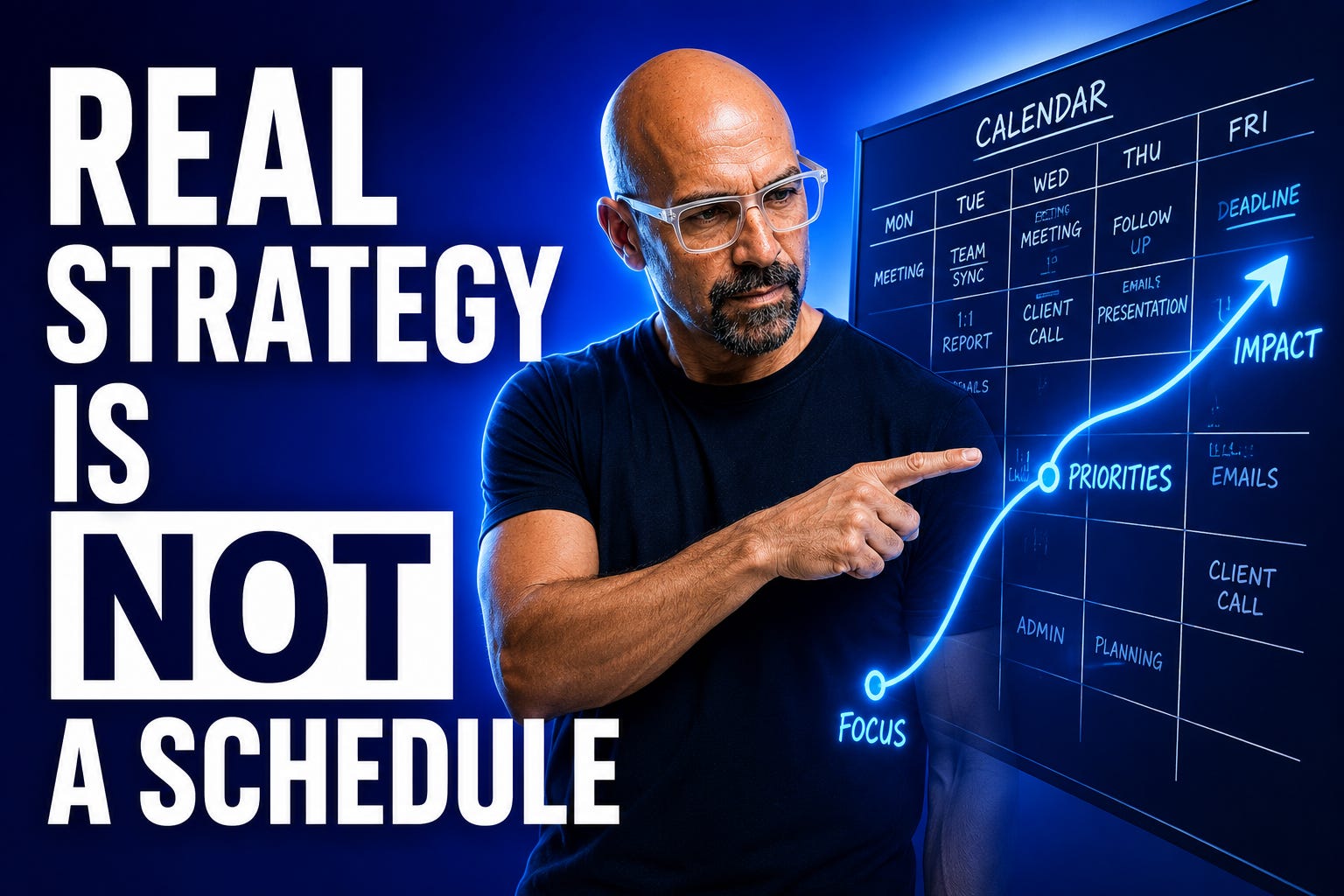
Every founder who has ever hired a content agency has been handed the same deliverable.
A calendar. Color-coded by content type. Mapped across platforms. Scheduled to the optimal posting time determined by an algorithm that has no idea what you are trying to build or who you are trying to become.
It looks like a plan. It functions like a treadmill - a lot of movement that deposits you in exactly the same place you started, just more tired.
The content calendar is not the strategy. It is what gets sold as strategy because strategy is harder to package, harder to explain, and harder to bill by the month.
Real content strategy is architecture. Not what you post or when you post it - but the structural logic underneath every piece of content you produce, connecting each one to a coherent body of work that compounds authority rather than simply accumulating posts.
Most founders have never been shown what that architecture looks like. Which is why most founders are busy, consistent, visibly present - and quietly wondering why none of it is converting into anything that matters.
Everyone Sells a Content System. Almost Nobody Sells a Content Architecture.
“You can’t connect the dots looking forward; you can only connect them looking backwards.”
Steve Jobs
The content industry has produced an enormous volume of advice about production - what to post, how often, which formats perform, how to repurpose, how to batch, how to use AI to scale output. All of it addresses the factory floor.
None of it addresses the blueprint.
Rather than talking about content strategy as a production problem, I want to show you the structural logic that thought leaders actually use to build authority over time - what the architecture looks like underneath the visible output, where AI fits into that architecture without flattening everything into the same voice, and how to build a content system that is working even when you are not posting.
We are going to start with the difference between content that accumulates and content that compounds, work through the actual layers of a real authority-building architecture, and arrive at something specific enough that you could redesign your entire approach this week. If you read this carefully, you will never look at a content calendar the same way again.
The Difference Between Accumulation and Compounding
“An investment in knowledge pays the best interest.”
Benjamin Franklin

Most content accumulates. Some content compounds.
The difference is not quality. It is not frequency. It is not even platform. The difference is whether each piece of content is a standalone output or a load-bearing element in a larger structure.
Accumulated content is a stack of posts. Each one produced, published, consumed, and replaced by the next. The audience reads it, maybe engages, moves on. The post does not make the next post more valuable. It does not build on what came before. It is a unit of output with no structural relationship to the units around it.
Compounding content is a body of work. Each piece reinforces the others - deepening a central argument, approaching a core idea from a new angle, adding a layer to a framework the audience has already started to internalize. The reader who encounters piece seven is not reading a new post. They are adding to a model they have been building in their mind since piece one.
Benjamin Franklin understood this intuitively - that knowledge, like capital, grows not through accumulation but through the interest each piece earns on the pieces before it. The same principle applies to a content body. Authority is not the sum of your posts. It is the compound interest of a consistent, coherent point of view expressed across time.
The architecture question is not “what should I post this week.” It is “what is the central body of thinking I am building, and how does this piece add to it.”
That question changes everything downstream.
The Four Layers of a Real Content Architecture
Think of content architecture the way a structural engineer thinks about a building.
There is a foundation - the core argument, the central thesis, the specific point of view that everything else is built on. There is a frame - the framework or system that organizes your thinking into something the audience can navigate and remember. There are the walls - the specific topics, angles, and formats that express the framework across different contexts. And there is the surface - the individual posts, essays, videos, and conversations that the audience actually encounters.
Most founders build only the surface. They produce the posts without the walls, the frame, or the foundation. Which is why the posts feel disconnected - because they are. There is nothing structural underneath them.
Here is what each layer actually requires.
Layer 1 - The Foundation: Your Central Argument.
Every thought leader who has built durable authority has one central argument. Not a niche. Not a topic area. A specific, contestable claim about how the world works in their domain - one that most people in their industry either haven’t considered or would reflexively disagree with.
Seth Godin’s central argument is that mass marketing is dead and that the only sustainable business strategy is finding and serving a specific tribe. Everything he has ever produced is an expression of that argument from a different angle.
Gary Vaynerchuk’s central argument is that attention is the asset and that most businesses are criminally underinvested in the platforms where attention currently lives. Every piece of content is that argument applied to a different context.
The central argument is not a tagline. It is not a mission statement. It is the specific, defensible, slightly uncomfortable claim that you are willing to spend years proving - because you have lived it and because you believe most people in your space have not yet seen it clearly.
Without a central argument, content has no foundation. It can be high quality, consistent, and well-distributed - and still feel like it adds up to nothing. Because nothing is holding it together.

Layer 2 - The Frame: Your Proprietary System.
The frame is the system or framework through which you express your central argument. It is the thing that makes your thinking navigable - that gives the audience a structure they can carry around and apply to their own situations.
The frame is what gets remembered when the specific post is forgotten. The audience may not recall the exact essay where you introduced the concept. But they remember the concept - and they attribute it to you. That attribution is authority.
The frame does not need to be complicated. It needs to be specific enough to be yours and useful enough to be applied. The know-like-trust sequence is a frame. The visibility spectrum from an earlier letter in this series is a frame. The voice stack is a frame. Each one organizes a set of ideas into something the reader can use and remember.
Building a frame is the highest-leverage content activity most founders never do. Because it requires sitting with your central argument long enough to understand its structure - not just its surface expression.
Layer 3 - The Walls: Your Topic Territories.
Once the foundation and frame exist, the walls are the specific topic territories that express them across different contexts - the four to six recurring themes that connect your central argument to the daily reality of your audience.
Each territory is a different entry point into the same building. A founder whose central argument is about trust economics in modern marketing might have territories around founder visibility, content architecture, network reactivation, brand positioning, and the mechanics of the sales conversation. Different topics - same underlying argument, expressed through a consistent lens.
The walls are what make a content calendar useful. Not as a production schedule - but as a rotation system that ensures every territory gets expressed regularly, so the body of work stays coherent and complete.
Layer 4 - The Surface: Individual Pieces.
The surface is what everyone can see. Posts, essays, videos, podcasts, comments, threads. The visible output.
At this layer, frequency, format, and platform decisions matter. But they matter far less than most content advice suggests - because a well-architected surface is almost self-generating. When the foundation, frame, and walls are solid, the individual pieces write themselves. The question is never “what should I post today.” It is “which territory am I in, what angle haven’t I expressed yet, and what is the most useful way to add to this body of work right now.”
That is a completely different creative experience from staring at a blank content calendar trying to manufacture something worth saying.

Where AI Fits (And Where It Destroys Everything)
“The factory of the future will have only two employees, a man and a dog. The man will be there to feed the dog. The dog will be there to keep the man from touching the equipment.”
Warren Bennis
AI is the most powerful content tool ever built for the surface layer.
It can draft, restructure, repurpose, reformat, expand, compress, and polish individual pieces faster and more consistently than any human production process. For the surface layer - the visible output - AI is genuinely transformative.
The mistake is using it at the wrong layer.
AI cannot build your foundation. It cannot identify your central argument because your central argument is not derived from patterns in existing data - it is derived from the specific collision of your experience, your observations, and your willingness to hold a position that most people in your space haven’t yet arrived at. That is, by definition, outside what any model can generate.
AI cannot build your frame. It can produce frameworks - endlessly, on demand, in any format you request. But a proprietary framework is not a structure that sounds useful. It is a structure that carries the fingerprint of a specific mind that has thought about a specific problem from a specific angle over a significant period of time. The model produces the shape. Only you can fill it with the weight of genuine understanding.
What AI does, when misapplied at the foundation and frame layers, is produce content that sounds exactly like everyone else who is also using AI at those layers. Which is, increasingly, everyone. The convergence is already visible - a flattening of voice, a homogenization of perspective, a proliferation of content that is structurally correct and intellectually empty.
The founders who are winning with AI are using it precisely: to accelerate surface production once the architecture is solid. They feed it a foundation and a frame and a territory and a specific angle - and then let it draft at speed. The output carries their architecture because the architecture was built by a human mind that AI cannot replicate.
The founders who are losing with AI handed it the whole job. And their content sounds exactly like it.
Scattered Presence Looks Like a Strategy. It Isn’t.
Scattered presence looks productive.
It looks like the founder who is active on LinkedIn, posting on X, sending a newsletter, appearing on podcasts, producing short-form video, and maintaining a presence on two platforms they joined because a consultant told them their audience was there. It looks like coverage. It looks like reach. It looks, from the outside, like someone who has figured out distribution.
What it actually is: surface without architecture. Output without foundation. Motion without direction.
The scattered founder is producing content that accumulates rather than compounds - each piece disconnected from the others, no central argument running underneath, no framework the audience is building in their mind, no body of work forming. Just posts. Lots of them. Across many platforms. Adding up to a vague impression that this person is active, without adding up to any clear sense of what they stand for or why you should pay specific attention to them over anyone else.
Scattered presence is what happens when the calendar becomes the strategy. When the production schedule substitutes for the architecture. When showing up is treated as sufficient rather than as the surface expression of something that needs to be built underneath it first.
The fix is not consolidation - moving from five platforms to two. The fix is foundation. Build the central argument. Build the frame. Define the territories. Then let the surface follow from the structure, on whatever platforms make sense, at whatever frequency the architecture supports.
Presence without architecture is just noise with a consistent posting time.

The Civilizational Pattern Running Underneath All of This
“It is not the strongest of the species that survives, nor the most intelligent. It is the one most adaptable to change.”
Charles Darwin
Every time a new communication technology lowered the cost of content production, the same pattern emerged.
The printing press made books abundant. The response was not more books - it was the canon. The agreed-upon body of work that represented the best thinking in a field, organized into a coherent intellectual tradition that could be built upon rather than simply added to.
The internet made articles abundant. The response was not more articles - it was the thought leader. The individual whose specific body of work organized a set of ideas well enough that people oriented around it rather than around the general topic.
AI is making competent content abundant. The response will not be more content - it will be the body of work. The coherent, architecturally sound accumulation of a specific point of view, expressed consistently enough and deeply enough that it becomes the reference point for everyone trying to think clearly about that domain.
Darwin’s principle applies here with unusual precision. The content that survives abundant production is not the strongest individual piece. It is the most coherent body of work - the one most structurally adapted to the environment of infinite surface noise.
The founders building that body of work right now have a window. Not a permanent one.
The content problem is not a production problem.
It never was.
It is an architecture problem. A foundation problem. A question of whether you have built something coherent enough underneath the visible output that each piece makes the next one more valuable - and that the whole, over time, adds up to something an audience can orient around, trust, and return to.
The calendar will not build that. The posting schedule will not build that. The AI tool will not build that.
You build it by sitting with your central argument long enough to understand it. By constructing a frame specific enough to be yours. By defining territories that give your thinking room to develop across time.
Then the surface almost builds itself.
And the content that was previously motion becomes, finally, momentum.
- Dennis

Most founders don't have a content problem.
They have a clarity problem.
They haven't decided what they want people to associate with their name, so every post starts from zero.
Absolutely, sustainable thought leadership comes from building a strategic content ecosystem where every insight compounds credibility, not just fills a publishing schedule.