


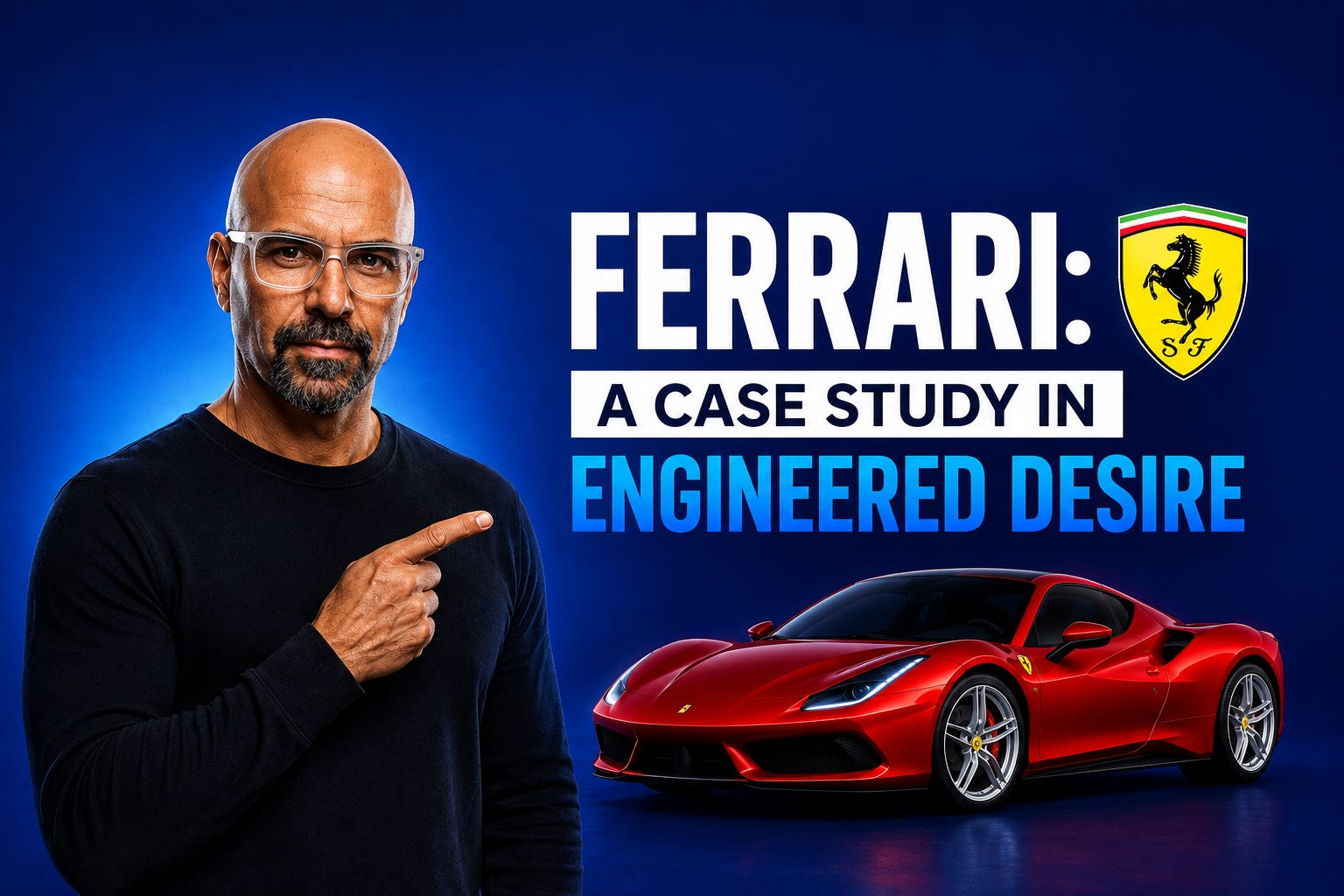
What Ferrari Actually Sells
Ferrari doesn’t sell cars. In 2023 they moved roughly 13,700 units worldwide, while Volvo sold about 52 times that many. If Ferrari were competing on volume, it would be a rounding error in the auto industry. Instead it is one of the most profitable, highest margin brands on earth, with an operating margin north of 28% and a market cap that has at times rivaled companies shipping a hundred times more product.
Ferrari sells access. Specifically, it sells the feeling of having been chosen.
Every mechanism in the business, production volume, the dealer relationship, the waiting list, the racing program, is built to protect and reinforce one core emotional promise: this is not for everyone, and you are one of the few who belongs here. The car is the receipt. The real product is the identity of “someone Ferrari selected.”
That distinction is the whole case study. Everything below breaks down the specific mechanisms Ferrari uses to manufacture that feeling, and how you can build the same mechanisms into a business of any size.
Mechanism 1: Manufactured Scarcity (Supply as a Marketing Lever)
Ferrari’s founder Enzo Ferrari set the rule decades ago, and current CEO Benedetto Vigna has restated it as policy: Ferrari will always build one car less than the market demands. This isn’t a supply chain limitation. Ferrari could build more cars and sell more cars. They choose not to, on purpose, every year.
The effect compounds. A waiting list that stretches past a year does three things at once:
It signals value before the buyer has even seen the product (”if I have to wait, it must be worth waiting for”).
It filters out impulse buyers and keeps the customer base concentrated among people who genuinely want in.
It protects resale value, which protects the psychology of every future buyer, because a Ferrari that holds or gains value isn’t a purchase, it’s an asset.
When Ferrari launched the Purosangue SUV, they deliberately capped it at under 20% of total shipments and closed the order books early, even while demand was climbing. They chose to say no to revenue in order to protect the feeling of scarcity.
The founder’s mistake this corrects: Most businesses treat “more demand than supply” as a temporary problem to solve. Ferrari treats it as the entire strategy, permanently.

Framework: The Scarcity Audit
Ask three questions about your own offer:
What would happen to perceived value if I served 20% fewer customers, but made the acceptance process harder to get through?
Is there a version of my product or service I intentionally limit in supply, whether by cohort size, seats, inventory, or time window?
Do my customers currently feel like they got in, or like they just paid?
You don’t need Ferrari’s price point to use this. A consultant capping client rosters at eight, a course that only opens twice a year, a product drop with a real (not fake) limited run, these all borrow the same psychology, as long as the scarcity is real. Fake scarcity gets detected and it burns trust permanently. Ferrari’s scarcity works because it is genuinely enforced, year after year, even under pressure to grow.
Mechanism 2: Reverse Selling (The Company Chooses the Customer)
This is the part most businesses never even consider, because it inverts the entire sales relationship. In most companies, the customer decides whether to buy, and the company tries to convince them. At Ferrari, especially for limited editions, the company decides who is worthy of buying, and the customer has to earn the offer.
Ferrari’s dealer network runs an informal but consistent vetting process. Loyalty to the brand, prior ownership history, and how a person represents the marque publicly all factor into whether they’re offered a car, particularly a limited edition. Ferrari has blacklisted celebrities, including high profile names, for behavior that didn’t match the brand’s image, and pulled dealership rights from buyers caught flipping cars for profit. Money alone has never been the qualifying criteria. As one longtime buyer put it, you never really know you’re getting one until you’re actually getting one.
This flips the emotional dynamic entirely. The customer isn’t thinking “should I buy this.” They’re thinking “will they let me.”

Framework: The Qualification Reframe
You can install a version of this at almost any price point:
Add an application, an intake call, or a qualifying criteria before someone can buy or work with you, even if you’d say yes to almost everyone. The friction itself signals value.
Explicitly state who you don’t work with. A page or paragraph describing your ideal client does more for perceived exclusivity than any discount ever will.
Reward loyalty with access. Give returning customers, referrals, or long term clients first look at anything limited. Ferrari does this constantly, existing owners get first access to new limited editions before anyone outside the family does.
Protect the brand on the way out too. Ferrari’s anti-flip clauses exist because what a customer does with the product after the sale still reflects on the brand. Consider what your customers do with your product publicly, and whether you have any say in protecting that.
The underlying principle: demand goes up the moment people sense they might be turned away.
Mechanism 3: Racing as the Proof, Not the Pitch
Ferrari’s road cars are not the center of the business, even though they generate the majority of the revenue. Ferrari’s Formula 1 program, Scuderia Ferrari, is the oldest and most storied team in the sport’s history, and it functions as a permanent, unpaid credibility engine. Every Grand Prix broadcasts the same message on repeat: this brand competes at the absolute limit of human and mechanical performance, every single weekend, in full public view.
Nobody has to take Ferrari’s word for it that their engineering is elite. It’s proven, in real time, on a global stage, dozens of times a year. That halo effect then transfers directly onto the road cars. Owning a Ferrari means owning a piece of the same DNA that’s on the grid.
This is the opposite of a typical marketing claim. Ferrari doesn’t say “we build the best performance engineering in the world.” They compete, publicly, and let the result say it.

Framework: Build Your Own “Racetrack”
Every business has a version of a public proving ground, a place where you can demonstrate mastery in a way that can’t be faked or bought.
What is the equivalent of your race day? A public body of work, a demonstrated result, a visible track record that proves the claim instead of stating it.
Are you telling people you’re the best, or are you showing them, in a venue they can watch?
Consider a “loss leader” credibility play, something you do that doesn’t directly make money but proves your capability so publicly that it sells everything else. Racing loses Ferrari money most years. It’s one of the highest ROI marketing expenditures in business history anyway.
Mechanism 4: Heritage as a Renewable Asset
Ferrari was founded in 1947 by Enzo Ferrari, a man who, according to the brand’s own mythology, was never chasing sales, he was chasing legacy. That founding story, obsessive, uncompromising, built on racing before road cars even existed, still gets told in every piece of Ferrari marketing today. The prancing horse logo, the signature Rosso Corsa red, the founder’s actual words are still quoted by the current CEO in investor materials nearly eighty years later.
Heritage isn’t nostalgia for Ferrari. It’s a renewable marketing asset that never depreciates and costs nothing to keep using, as long as it stays true to the original values.
Framework: Excavate Your Origin Story
Most businesses have an origin story and never use it. Ferrari uses theirs in almost every touchpoint.
What was the actual reason your business exists, the specific frustration, obsession, or gap that started it? Not the polished version, the real one.
Is there a founder’s belief or rule, similar to Enzo Ferrari’s “one car less than demand,” that you could turn into a repeated brand mantra?
Are you telling this story once, on an About page, or are you weaving it into product names, campaigns, and customer communication on a rolling basis?
Mechanism 5: Brand Extension Without Dilution
Ferrari has expanded into fashion, theme parks, hospitality, and lifestyle products, categories that have nothing to do with cars. Most brands that stretch this far dilute themselves into irrelevance. Ferrari hasn’t, because every extension gets filtered through the same three attributes: performance, exclusivity, Italian excellence. A Ferrari branded jacket has to earn the badge the same way a car does. If it doesn’t reinforce those three attributes, it doesn’t happen.
This is what branding theorists call the “griffe” effect, a brand strong enough that it doesn’t just label a product, it ennobles it. The brand transfers value into the object rather than borrowing value from it.
Framework: The Extension Filter
Before you add a new product, service, or offer to your business, run it through your own three word filter, the same way Ferrari does:
Name the three non-negotiable attributes your brand stands for.
Ask honestly whether the new offer reinforces all three, or whether it’s being added purely because it’s profitable or trendy.
If it doesn’t pass the filter, it doesn’t launch under your name, even if it makes money elsewhere.
This single discipline is the difference between a brand that compounds in value over decades and one that quietly erodes its own meaning one convenient decision at a time.

The System Underneath the Marketing
None of this works without operational infrastructure. This is the “systems and workflows” layer that makes the emotional brand promise deliverable at scale:
Allocation systems. Ferrari’s production planning isn’t just manufacturing logic, it’s a marketing tool. Deciding, in advance, exactly how many units of each model will exist is a workflow decision with direct brand consequences. Translate this to your business: your capacity planning and your positioning should be the same conversation, not two separate departments.
Clienteling infrastructure. Ferrari tracks ownership history, loyalty, and behavior across its dealer network so that “who gets offered what” can actually be executed consistently worldwide. Exclusivity without a system to track and enforce it is just a slogan. If you promise your best clients first access, you need an actual CRM workflow that makes that promise operational, not aspirational.
Brand governance. Every licensing and extension decision runs through a filter before it ships. That’s a repeatable internal review process, not a one time gut check. If you’re growing, build the checklist version of your three word filter now, before you’re moving too fast to apply it.
The emotional brand and the operational system are not separate strategies. Ferrari’s scarcity feels effortless to the customer because it’s rigorously engineered on the inside.
The Ferrari Playbook, Condensed
Protect scarcity on purpose. Don’t just meet demand, engineer a gap between what people want and what you’ll provide.
Make the customer earn it. Add real qualification, even lightweight, so buying feels like being chosen.
Prove it publicly instead of claiming it. Find your version of the racetrack and compete where everyone can watch.
Mine your origin story continuously. Turn the real reason you started into a recurring brand asset, not a one time page.
Filter every extension through your core attributes. Growth that doesn’t reinforce your identity is growth that erodes it.
Build the operational system that makes the promise deliverable. Exclusivity, loyalty rewards, and consistency all require infrastructure, not just intention.
Ferrari has spent eighty years proving that the smallest, hardest to get thing in a category can also be the most valuable thing in it. The lesson isn’t “sell fewer units.” The lesson is that value is a story you control on purpose, at every layer of the business, or it’s a story the market writes for you by default.
If you’re ready to take your brand to the next level, drop a line. We take on about 20 clients per year. Let’s see if it’s a good fit.


Imagine getting to the point where telling a customer “sorry, you can’t buy this” makes them want it more. Most founders would’ve added a discount code by lunchtime.
Exactly, Ferrari’s lesson is less about scarcity itself and more about disciplined positioning: protecting perceived value can matter more than maximizing short-term volume.