



Most companies sell products. A rare few sell realities.
Disney is the most misunderstood brand in the history of business. Everyone credits the movies. Everyone credits the parks. Everyone credits the nostalgia. And in doing so, they miss the only thing that actually matters - the one mechanism that turns a cartoon mouse into the highest-grossing entertainment company in human history.
It isn’t magic. But it’s the closest thing to it that business has ever produced.
Most brands sell you something. Disney sells you a place to be from.
“Man is most nearly himself when he achieves the seriousness of a child at play.”
Heraclitus
There isn’t a day that goes by where you don’t see a Fortune 500 brand spend nine figures trying to manufacture emotional connection and come back with a logo refresh and a tagline nobody remembers.
Disney never had to try.
Because Disney didn’t build a brand. It built a cosmology - a complete, internally consistent universe with its own physics, its own heroes and villains, its own moral logic. And once you grow up inside that universe, you don’t just buy from Disney. You live in it. You carry it. You pass it to your children like a cultural inheritance.
That’s not marketing. That’s civilizational infrastructure.
What every other entertainment company gets catastrophically wrong
Rather than talking about Disney’s content strategy or park economics, I want to give you something different.
I want to show you why Disney operates on a completely different plane than every competitor it has ever faced - and why that gap is not about resources, not about talent, and not about luck.
It’s about dimensional thinking.
We’re going to start with how most brands see themselves and work toward how Disney sees reality. If you read carefully, you will understand why copying Disney is structurally impossible - and what that means for how you should build your own brand.
If you sell a product, you are already behind
Most companies live in what I’d call 1D brand thinking.
One dimension. One value proposition. One reason to buy.
1D thinking looks like this:
Our product has better features
Our price is more competitive
Our customer service is faster
Our design is cleaner
Our story is more authentic
None of this is wrong. All of it is irrelevant at scale.
Because every competitor can copy features. Price is a race to zero. Service is table stakes. Design is a weekend sprint. And “authentic story” is now a commodity you can buy from a brand agency in Brooklyn for $40,000.
Disney never competed on any of these dimensions. Not once.
Walt Disney’s operating insight - which he had in 1928 and which nobody in Hollywood fully absorbed until it was already too late - was that the unit of value is not the product. The unit of value is the world.
A world cannot be copied. A world cannot be commoditized. A world takes decades to build and, once built, becomes nearly indestructible.
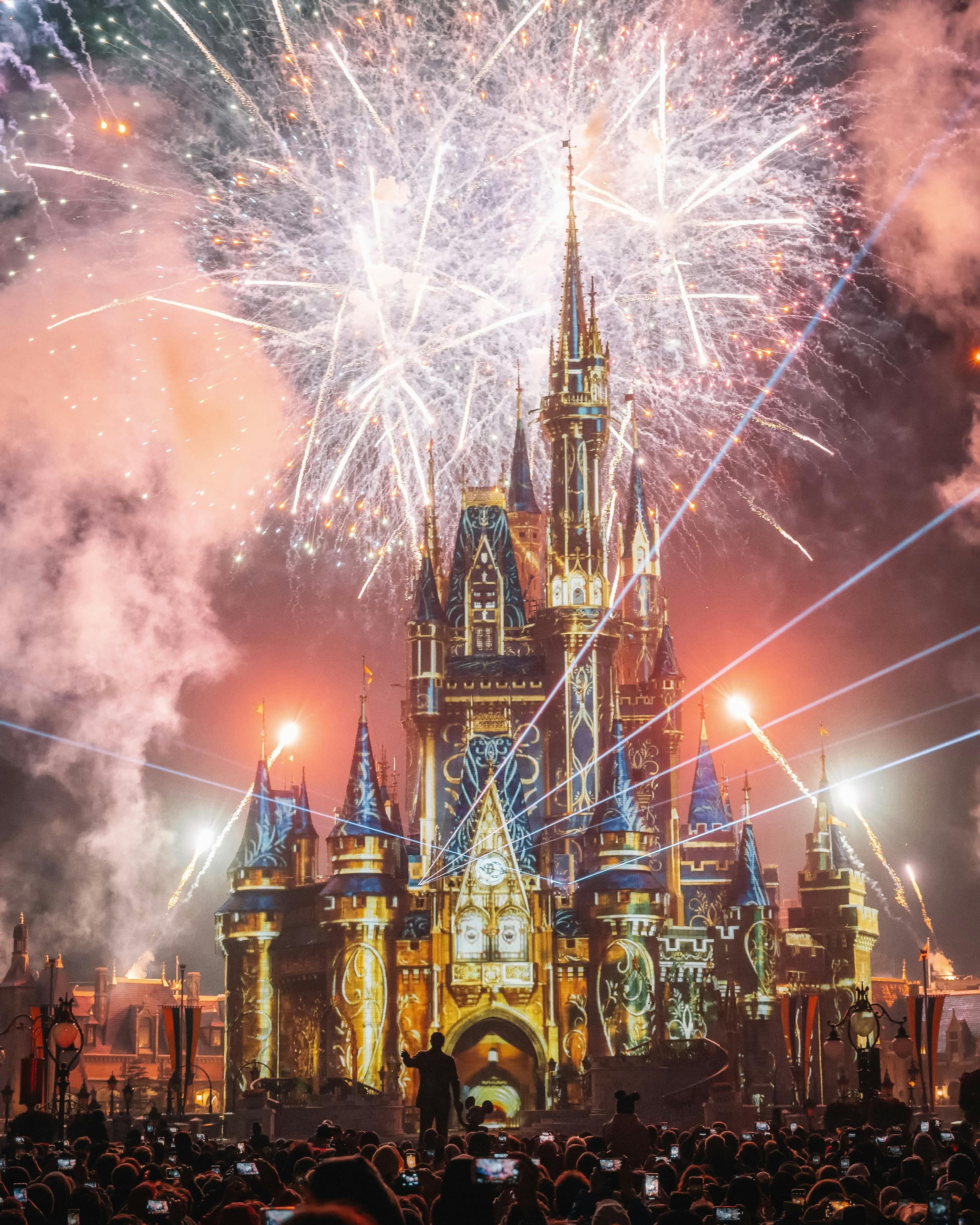
The flywheel that ate Hollywood
“You can dream, create, design, and build the most wonderful place in the world. But it requires people to make the dream a reality.”
Walt Disney
Think about what Disney actually owns.
You watch a Marvel film. You take your daughter to Disneyland. She buys a Princess dress. You stream Bluey on Disney+. You visit Star Wars: Galaxy’s Edge and you hold a lightsaber that feels real. You go home and your daughter draws Moana on a napkin. She knows all the words to the songs. She asks to go back next summer.
Now answer this: where does the product end and the belief begin?
You cannot find the line. That is the entire strategy.
This is what I call the World Flywheel. Every asset Disney owns is not a business unit - it’s an entry point into the same world. The film makes the park meaningful. The park makes the merchandise feel like a piece of something real. The merchandise makes the streaming content feel personal. The streaming content drives back to the film.
The flywheel does not stop. It has been spinning since 1937.
(By the way, if you’ve studied systems thinking at all, you’ll recognize this as a reinforcing feedback loop with no obvious equilibrium point. It compounds forever - until the world itself becomes culturally irrelevant. Which, to date, Disney’s core IP has resisted for nearly a century.)
The acquisition playbook nobody talks about honestly
Here’s the part that sounds conspiratorial but is entirely observable in the financials.
Disney’s acquisition strategy - Pixar in 2006, Marvel in 2009, Lucasfilm in 2012, 21st Century Fox in 2019 - is not a content acquisition strategy. It is a world annexation strategy.
They didn’t buy Pixar because Pixar made good movies. Every studio knew Pixar made good movies.
They bought Pixar because Pixar had its own mythology, its own rules of emotional resonance, its own devoted audience - and all of that mythology was perfectly compatible with the Disney cosmology. It could be absorbed. Integrated. Made native.
Same with Marvel. Same with Star Wars.
Imagine you built a nation-state with functioning geography, language, currency, and citizenry. Now imagine you found three neighboring nation-states whose citizens were already culturally pre-disposed to assimilate into yours. You don’t just buy territory. You absorb entire populations of believers.
That’s not M&A. That’s empire building. And it follows the same logic that every empire in history has followed: find adjacent belief systems, absorb them, and expand the borders of your world.
I’ll let you think about where that can go with AI-generated content at infinite scale.
What Walt actually understood that nobody taught him
“The uncreative mind can spot wrong answers, but it takes a very creative mind to spot wrong questions.”
Anthony Jay
Walt Disney had no formal business training. No MBA. No strategic framework from McKinsey. He built the most durable entertainment brand in human history on a single operating principle he never named but always practiced:
The story is the strategy.
Not a story about the brand. Not a brand narrative in the marketing sense. The actual story - the characters, the worlds, the moral stakes, the emotional logic - is itself the strategic architecture from which all monetization naturally follows.
Every competitor Disney has ever faced started from the opposite direction. They started with the business model and worked backward to content that could support it. Disney started with the story and let the business model emerge from what the story demanded.
A story demands a world you can walk through. Hence the parks.
A world you walk through demands artifacts you can take home. Hence the merchandise.
A story lives in you forever. Hence the streaming.
A story grows when it collides with other stories. Hence the acquisitions.
None of this was inevitable. But all of it was structurally implied by the original commitment: build a world first, figure out how to live in it second.
The dimension most brands never reach
There’s a level of brand existence almost no company ever achieves. I’d call it 4D brand thinking - where the brand exists not just in the customer’s purchasing behavior, not just in their emotional preference, not just in their identity, but in their mythology.
Mythology means the brand becomes part of how someone explains reality to themselves.
A child who grows up with Disney doesn’t just like Disney. Disney is part of the framework through which they understand good and evil, courage and fear, love and loss. Simba’s journey. Elsa’s isolation. Wall-E’s loneliness. These are not entertainment. They are the first philosophical education most Western children receive.
(Krishnamurti spent his entire life arguing that humans are imprisoned by the conditioning they absorb in childhood without examining it. He was talking about religion and culture. He didn’t live long enough to see what a privately owned mythology company could do with that insight at scale.)
When your brand becomes part of how someone understands the world, you have transcended competition entirely.
You are no longer a company people choose. You are a world people belong to.
The real lesson most founders miss entirely
The answer is not content. The answer is not IP. The answer is not the flywheel.
The answer is commitment to world-building before revenue optimization.
Walt Disney nearly went bankrupt three times. He signed away personal assets to finish Fantasia. He bet the entire studio on Disneyland when every analyst told him theme parks were a dying format.
He was not managing a content portfolio. He was building a world and refusing to stop until it was real enough for people to live inside.
Most founders - most brand builders - optimize for the next 18 months. They build products that generate revenue. They develop IP that can be licensed. They create content that performs in the algorithm.
Disney built something people would still be visiting in their eighties with their grandchildren - not because the rides are thrilling, but because the world is so deeply embedded in who they are that returning to it feels like coming home.
That is the thing that cannot be manufactured. It can only be earned through decades of absolute commitment to making the world feel real.
Every brand at every scale faces a version of Disney’s original choice: do you optimize for the transaction, or do you build the world?
The transaction pays this quarter. The world pays for a century.
You already know which one most companies choose. Now sit with which one you’re choosing.
Have you built your world?
Would love to hear from you.
- Dennis
Very interesting read! Mickeys is a worldwide icon