
The loudest voice in health right now never went to medical school.
He has a ring light and a webcam.
He has abs you could grate cheese on. And he has a very strong opinion about seed oils.
He’ll tell two million people exactly what to eat to look like him. Eggs, steak, black coffee, no carbs after 2pm. Do this and you’ll get these results.
You won’t.
Because what a lot of these guys aren’t mentioning is what they’re injecting into their thigh every Tuesday. No breakfast on earth gets you those results. Not eggs. Not steak. Not a single blueberry hand-picked by monks.
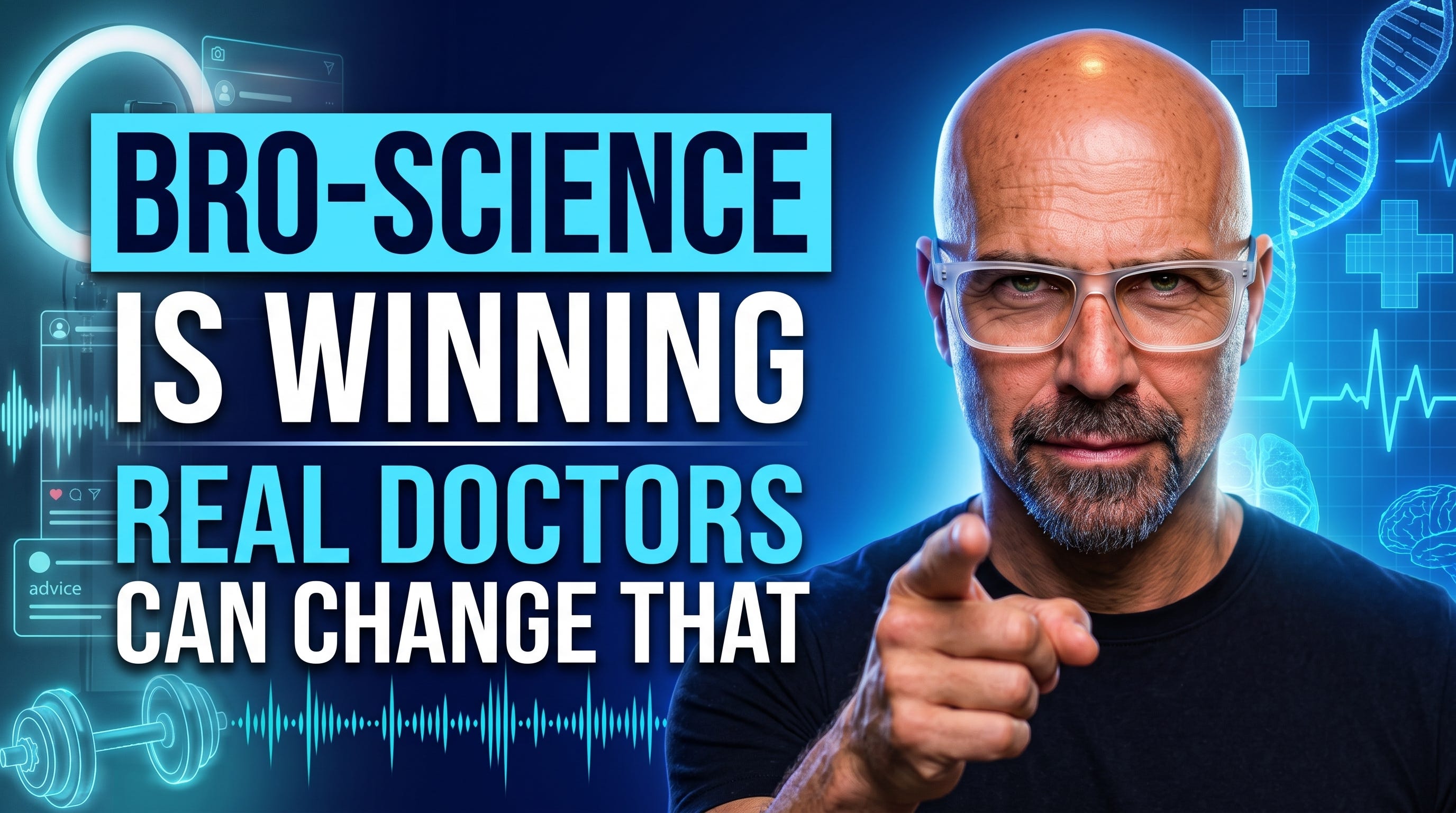
That is bro-science.
And bro-science is winning.

Recycled advice at microwave speed
Here’s how it works. One guy hears something on a podcast. He repeats it in a video. Another guy watches that video and repeats it with more confidence and better lighting. By the fifth round, it’s gospel.
Nobody in that chain has examined a patient. Nobody read the study. Most of them haven’t read the label on their own supplements.
This is not a future prediction. This is Tuesday.
Doctors see it every day. 65% of physicians now say misinformation significantly affects their ability to deliver care. A year ago it was 57%. 85% say social media regularly feeds their patients bad information. 74% point straight at influencers.
So the patient walks in already “educated.” He spent the weekend doing his own research, which means three videos from people who also did their own research.
And the surgeon with 15 years of training gets 12 minutes to undo it.

How I actually use this stuff
Full disclosure. I use AI every day. Including for my health.
Before I make a decision, I’ll often ask Claude about it. What are my options? What questions should I be asking? What does the research generally say?
Then I take all of that to my doctor.
Alongside my doctor. Not instead of my doctor.
That’s the line. And most people are stepping right over it.
AI, Google, YouTube, the guy at the gym... they can make you a better-prepared patient. They can’t replace the person who has examined your body, read your bloodwork, and seen 10,000 cases like yours.
The tools aren’t the problem. Swapping the expert for the echo is the problem.
Where did the doctors go?
Here’s what frustrates me.
The people with the actual credentials are mostly silent.
The endocrinologist with 20 years of practice has 312 followers and a LinkedIn photo from 2011. Meanwhile a 24-year-old who read half a blog post is telling a million people how to fix their thyroid.
Most medical experts agree professionals should push back on misinformation. Only 55% have actually shared health information on social media.
I get it. Doctors are busy. They’re trained to be careful. And writing content is a completely different skill.
A surgeon can replace a hip in under an hour. Flawlessly. Thousands of times. Ask that same surgeon to write a LinkedIn post that stops a stranger mid-scroll, and you’ll get a post that reads like a journal abstract. Or no post at all, because it’s been sitting in drafts since March.
Nobody expects the guy with the ring light to do a knee replacement. So why do we expect the surgeon to be a copywriter and a brand strategist at 10pm after a full day of cases?
But silence isn’t neutral. When the qualified people step back, the unqualified people step up. Somebody is going to fill that space.
Right now it’s the guy with the ring light.

The opportunity hiding in plain sight
Here’s the good news. And it’s really good news.
In the same research, physicians said the thing patients still trust most is their personal relationship with their doctor.
Not the institution. Not the hospital logo. The person.
That’s a brand. A human one.
We’re living in an AI, automated, microwaved world. Content is cheap. Anybody can generate a thousand posts about gut health before lunch. And because everything is getting faster and more artificial, the real thing is getting more valuable, not less.
A real surgeon. With a real face. Saying “here’s what the evidence says, and here’s what I tell my own patients.” Plainly. Consistently.
That cuts through the noise like nothing else.
Doctors already have what influencers fake. The training. The credentials. The outcomes. The years. What most of them don’t have is a voice people can find.
That’s fixable. It’s exactly what we do at Elite Leaders.
What a human medical brand looks like
It’s not dancing on TikTok. (Unless you want to. I’m not your mom.)
It’s simple:
Show your face. People trust people, not logos.
Answer the questions patients actually ask. The ones you hear ten times a week.
Correct the nonsense calmly. No mocking. Just “here’s what’s true, and here’s why.”
Talk like you do in the exam room, not like a journal abstract.
Show up regularly. Trust is built on repetition.
Simple. Not easy. Especially the last one.
That’s the part we handle. We sit down with doctors and surgeons, learn how they think, how they talk to patients, and what makes them different. Then we turn that into consistent content in their voice, working quietly in the background.

The doctor stays the expert. We do the writing and the strategy. They focus on patients and building the practice.
That is it. That is the whole game.
The influencer has charisma and a hook. You can have charisma, a hook, and a medical degree. That’s not a fair fight.
It just hasn’t started yet.
So here’s my question for the doctors, surgeons and medical professionals reading this:
If you don’t become the trusted voice in your field, who will?
And if you’d like some help becoming that voice, you know where to find me.