


In 1994, a man named Jeff Bezos was driving across the country with his wife. He wasn’t on vacation. He was on a mission. He had just quit a very good job in New York City because he saw something that looked like a miracle: the internet was growing by 2,300% every single year.
Most people back then didn’t even know what the internet was. But Jeff had a “Crazy Idea.” He decided to open a bookstore that didn’t have any actual shelves. He moved into a small house in Seattle and started his business in the garage.
To save money, Jeff didn’t buy fancy office furniture. He went to a local hardware store, bought a solid wooden door, and nailed four pieces of wood to it to make a desk.
He once said, “I knew that when I was 80, I was not going to regret having tried this. I was only going to regret it if I didn’t try.” He called this his “Regret Minimization Framework.”
It was the spark that started a fire that would eventually consume the world of retail.
If you’re an investor, or just starting to learn how to invest WISELY, here is a FULL Financial Analysis of Amazon. You can access it here:👇🏼


1. The Flywheel: The Secret Engine of Growth
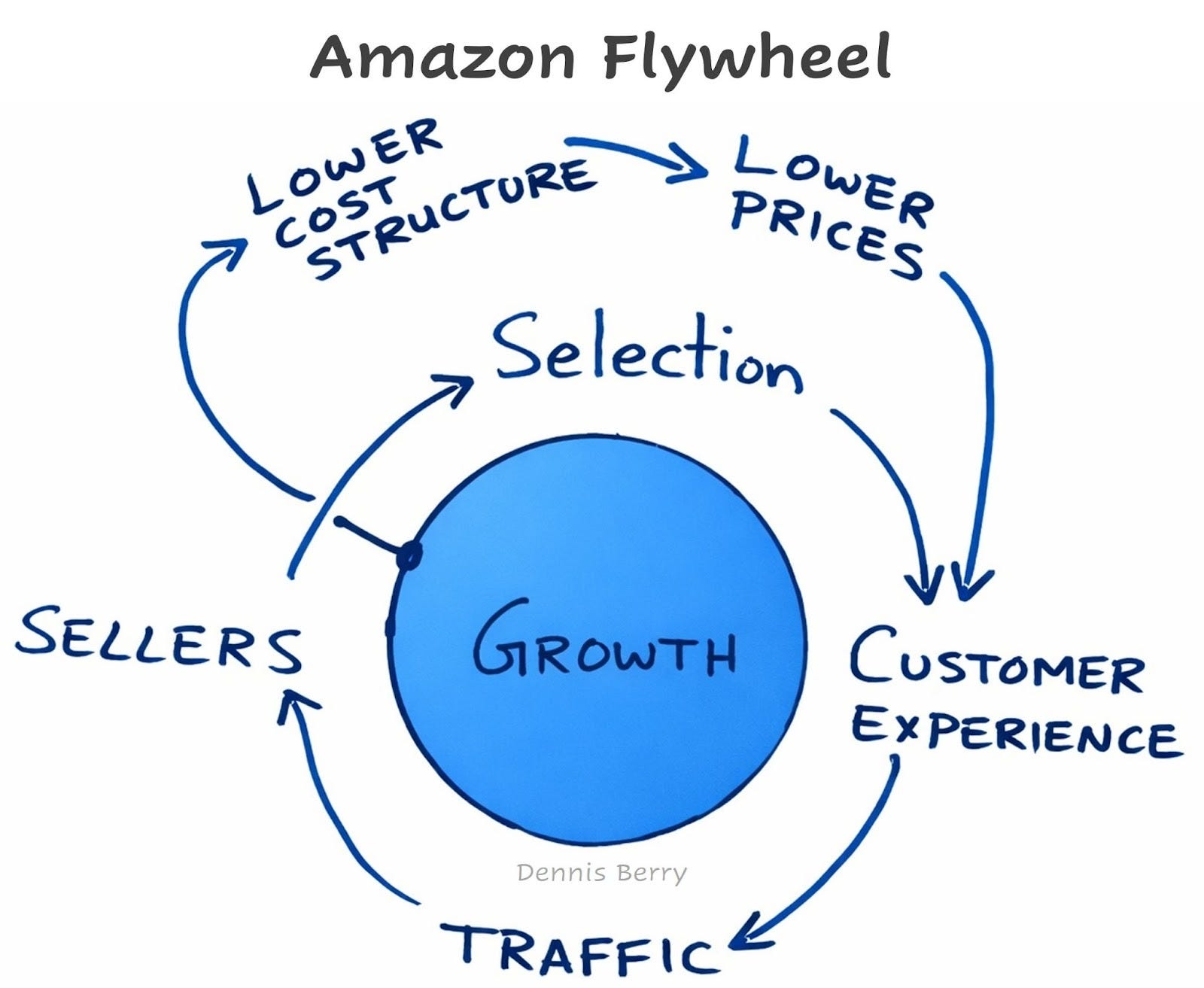
Jeff Bezos knew that if he wanted to be the biggest store on Earth, he couldn’t just sell books. He needed to build an engine that would never stop. He drew a circle on a napkin and called it the “Flywheel.”
The idea was simple: If Amazon could keep prices low, more people would shop there. When more people shopped there, more sellers would want to list their products on the site. When there were more products, customers would have more choices, which would bring in even more shoppers.
This cycle created a massive amount of growth. It allowed Amazon to build huge warehouses and buy their own delivery trucks. A famous study by McKinsey & Company found that companies using this kind of “big data” and smart logistics could reduce their costs by an average of 15%.
Amazon used every penny of those savings to make prices even lower for you. They didn’t just want to be a store; they wanted to be an “Everything Store” that you could never imagine living without.
2. The Evolution of the Smile: A Visual Journey
In the beginning, Amazon didn’t have the famous logo we see today. The very first logo in 1995 was a giant “A” with a blue river flowing through it. It was simple because Jeff didn’t want to spend much money on fancy designs. But as the company grew, the brand had to change.
For a short time in the late 90s, they even tried a logo with zebra stripes! It was confusing and didn’t last long. Finally, in the year 2000, they created the “Smile” logo we all know. It looks like a simple orange swoosh, but it has two hidden meanings:
The A to Z: The arrow starts at the letter ‘a’ and points to the letter ‘z.’ This tells the world that Amazon sells everything from A to Z.
The Happy Customer: The arrow is curved to look like a smile. It tells you that the brand’s main goal is to make you happy.
A study from Stanford University on “Visual Cognition” suggests that human brains process symbols like a “smile” much faster than words. By putting a smile on every box, Amazon wasn’t just shipping a product; they were shipping a “positive feeling” directly to your doorstep.
3. The Digital War: How Amazon Won the Marketing Game
Amazon didn’t just wait for people to find them; they went out and hunted for customers using the internet. One of their biggest secrets was how they used Google Paid Ads.
While other stores were buying big, expensive ads on TV, Amazon was buying millions of small “keywords” on Google. If you searched for a rare book about “blue frogs in Brazil,” Amazon would have an ad waiting for you. This is called “Long-Tail Marketing.” They realized that if they could win millions of small searches, they would eventually win the whole market.
They also invented the Amazon Associates program. This was the first giant “Affiliate” program where they paid regular people to link to Amazon products on their own websites. It turned the whole internet into a sales team for Jeff Bezos. Instead of having a few thousand employees, they suddenly had millions of people helping them sell products.

4. Branding Psychology: The Empty Chair
While other companies were busy watching what their rivals were doing, Amazon was busy watching you. Jeff Bezos has a famous rule called “Customer Obsession.” He doesn’t want to just satisfy customers; he wants to delight them.
In the early days, Jeff would bring an empty chair into important meetings. He told his leaders that the chair belonged to “the most important person in the room” - the customer. He wanted everyone to remember who they were actually working for.
He once compared a business to a party, saying: “We see our customers as invited guests to a party, and we are the hosts. It’s our job every day to make every important aspect of the customer experience a little bit better.”
This focus worked. According to a 2026 report from Forbes, Amazon remains one of the most trusted brands in America. The study found that when people feel a brand really cares about their experience, they are 88% more likely to stay loyal to that brand even if a cheaper option comes along.
Amazon earned this trust by making shopping feel like magic - you click a button, and a box appears at your door the next day.
5. Infrastructure: The Two-Pizza Rule
As Amazon grew from a few people in a garage to over 1.5 million employees, Jeff Bezos worried that the company would become slow and boring. To stop this, he created the “Two-Pizza Team” rule.
He believed that any team should be small enough that you could feed the whole group with just two large pizzas. If the team was bigger than that, it was too big to get things done quickly. These small, fast teams were allowed to take big risks and even fail.
This is how Amazon built its massive infrastructure - from robots that sort packages in seconds to a fleet of airplanes that fly through the night.
6. Diversification: The Cloud and Beyond
By the mid-2000s, Amazon had become so good at running its own computer systems that they decided to start a new business called Amazon Web Services (AWS). They started renting out their computers to other companies.
At first, people thought this was a weird move for a bookstore. But today, AWS is the “hidden brain” of the internet. A 2026 study by Harvard Business Review notes that AWS now holds about 31% of the entire global cloud market. This means that a huge part of the websites and apps you use every day - like Netflix or your favorite video games - actually run on Amazon’s computers.
This part of the business is incredibly valuable. Even though it is smaller than the online store in terms of total sales, it makes more than half of the company’s total profit. It’s the “Cash Cow” that pays for all the other “Crazy Ideas” Amazon wants to try next.
7. Amazon in 2026: The New Era of AI
As we look at Amazon today in 2026, the company is changing once again. Jeff Bezos has stepped back, and the new leader, Andy Jassy, is leading the charge into the world of Artificial Intelligence (AI).
Amazon is no longer just about boxes and websites. It is about intelligence. They are using AI to predict what you want to buy before you even know you want it. They are even building “AI Agents” that can do your grocery shopping or plan your vacations for you.
Andy Jassy recently said, “I passionately believe that every customer experience that we know of today is going to be reinvented.”
Where the Money Comes From in 2026:
The business today is like a giant three-legged stool:
The first leg is the Online Store, which controls about 38% of all online shopping in the United States.
The second leg is Advertising, where brands pay Amazon billions of dollars - nearly $94 billion projected this year—to show you their products first.
The third leg is AWS, which continues to grow at over 20% every year.
The Leadership Lesson: It is Always “Day 1”
Even though Amazon is now a trillion-dollar giant, they still try to act like a small startup. Jeff Bezos always said that it is always “Day 1” at Amazon. “Day 2” is the beginning of the end.
For leaders, the lesson of Amazon is that you must never stop inventing. You have to be willing to be misunderstood for a long time. You have to be willing to fail. But most importantly, you have to be obsessed with your customer. If you can make their life easier, they will give you the world.
The story of Amazon is far from over; in fact, if you ask the leaders in Seattle, they will tell you we are still in the early morning of “Day 1.” Over the next year, Amazon is focused on a total “AI Overhaul,” turning every part of their store into a personal concierge that knows what you need before you do.
By five years out, the goal is “The Invisible Store.” Through their “Just Walk Out” technology and a massive fleet of Prime Air drones, they want the time between “wanting” something and “having” it to drop from hours to mere minutes, making the physical act of shopping almost disappear.
Looking ten years into the future, Amazon’s vision stretches beyond our atmosphere. Through Project Kuiper, they are launching thousands of satellites to provide high-speed internet to every corner of the Earth, ensuring that the next billion customers can connect to the “Everything Store.”
Jeff Bezos once said, “If you’re competitor-focused, you have to wait until there is a competitor doing something. Being customer-focused allows you to be more pioneering.”
Whether it is delivering packages by robot on Earth or building the infrastructure for life in space, Amazon’s ultimate goal is to become the underlying operating system for modern life itself.
To create great products that customers love, one must be customer obsessed just like Jeff Bezos and Amazon!
High obsession quotient ✨