


Most companies sell products. A rare few sell feelings - and fewer still have figured out how to sell the same feeling for over a century without it getting stale.
BMW is one of them. And the reason almost nobody talks about why it works is because most people are too busy admiring the car to study the philosophy underneath it.
That is not an exaggeration. And if you consider yourself someone who studies business, marketing, or brand-building - you are the most likely to have missed the actual lesson here.
This isn’t a story about a car company. It’s a story about identity, survival, and what happens when an organization knows exactly what it stands for - even when the world keeps trying to make it forget.
We’re going to start with an aircraft engine manufacturer fighting for survival and work toward a marketing framework that almost nobody is using, but that every great brand in history has followed by instinct or by design. If you read carefully, you will never look at your own brand - or business - the same way again.

If you’re an investor, or just starting to learn how to invest WISELY, here is a FULL Financial Analysis of Amazon. You can access it here:👇🏼

1. BMW Didn’t Start With Cars. It Started With a Problem.
“The significant problems we face cannot be solved at the same level of thinking we were at when we created them.” - Albert Einstein
In 1916, a company called Bayerische Flugzeugwerke was building the best aircraft engines in Germany. They were good at one thing: engineering things to operate at the limit of human performance.
Then World War I ended. The Treaty of Versailles banned Germany from building aircraft engines. Overnight, their core product became illegal.
Most organizations at this moment would have collapsed. Many did. BMW did something different - they asked a question that almost no organization thinks to ask: What is the real thing we’re good at?
Not “what do we make” but what do we actually do at the highest level of abstraction?
The answer wasn’t “aircraft engines.” The answer was precision engineering in service of human performance.
That distinction saved the company.
They built railway brakes to survive. Then motorcycles. Then cars. Every pivot was not an abandonment of identity - it was the same identity applied to a new problem. The 1923 R32 motorcycle used a Boxer engine design so fundamentally sound that BMW still uses a version of it today. One hundred years later.
That is what it looks like when a company knows what it actually is.
Imagine you ran a consulting business that lost its biggest client. Most people would scramble to replace that client with something similar. The better move is to ask: what am I actually solving for these people? The answer to that question might open a market ten times bigger than the one you just lost. BMW pivoting from aircraft engines to motorcycles to cars is the same move. The vehicle changes. The core never does.
2. The Framework Nobody Teaches: Identity-First Positioning
“It is no measure of health to be well adjusted to a profoundly sick society.” - Jiddu Krishnamurti
Here’s what every marketing course will tell you about brand positioning: find a gap in the market, differentiate on a feature, articulate your unique value proposition, and target the right demographic.
Rather than walk through what everyone else teaches, I want to give you something that actually explains why BMW works - and why most businesses never achieve what BMW has.
The framework is simple, and it operates on three levels.
Level 1: Feature Differentiation - You are better at a specific thing. “Our car has more horsepower.” “Our software loads faster.” This works until a competitor matches you. Feature differentiation has a ceiling and that ceiling is always getting lower.
Level 2: Emotional Positioning - You associate your product with a feeling. “Our car = freedom.” “Our software = confidence.” This is better. It’s harder to copy a feeling than a feature. BMW entered this level in 1973 with a single phrase: The Ultimate Driving Machine. Not “a very good car.” Not “a precise vehicle.” The ultimate driving machine. The definitive article. A declaration, not a description.
Level 3: Identity Embedding - Your brand becomes a statement about who the buyer is. Not what they do, not how they feel - who they are as a person. At this level, buying your product is not a transaction. It is an act of self-expression. It is identity confirmation in material form.
BMW operates at Level 3. Has for decades.
The buyer is not buying a car. The buyer is declaring, to themselves and to the world, that they are someone who cares about the drive - about being present, capable, in command. The car is the symbol. The identity is the actual product.
This is why BMW can charge a premium that logic alone cannot justify. You don’t argue someone out of a belief about who they are.

3. The 1959 Near-Death Experience That Explains Everything
Most companies optimize for the next quarter. The Quandt family, who saved BMW from bankruptcy in 1959 by doubling down instead of selling to Mercedes, still own close to 47% of the company today.
Think about what that means structurally.
The company that almost ceased to exist is still, 65 years later, controlled by the people who bet on its survival. That is not a financial footnote. It is the structural explanation for why BMW makes decisions that no publicly traded company - accountable only to quarterly earnings calls - could ever make.
Long-term thinking is not a personality trait. It is an organizational architecture.
When you have shareholders who will be dead before their investment thesis is fully proven, you make different choices. You invest in a new electric platform for ten years before the market is ready. You launch a cinema-quality film series in 2001, four years before YouTube exists, because you understand where attention is going and not just where it currently is. You protect brand equity even when it would be profitable in the short term to dilute it.
The businesses that build for decades instead of quarters are the businesses that end up defining their categories.
Most people building businesses today have never thought seriously about what kind of organizational architecture they’re actually inside - and whether that architecture is capable of producing the outcomes they say they want. That is not an exaggeration.
4. The Hire: What Happens When You Treat Your Customer’s Intelligence as an Asset
“The measure of intelligence is the ability to change.” - Albert Einstein
In 2001, BMW recognized something that almost the entire advertising industry was ignoring: their target customer was spending more time online, watching less television, and had become resistant to traditional product-focused advertising.
Rather than run another glossy car-on-a-mountain-road commercial, they did something that had no precedent in the industry. They hired eight world-class film directors - including Guy Ritchie, Wong Kar-Wai, Ang Lee, John Frankenheimer, and Ridley Scott’s production company - and produced eight cinematic short films featuring Clive Owen as “The Driver.”
The cars were in the films. They were not the subject of the films.
The distinction sounds subtle. It is not subtle at all.
By placing the car inside a genuine story - where the car’s performance mattered to the plot - BMW converted advertising into entertainment. They were not interrupting the viewer. They were the thing the viewer chose to watch.
The results were not ambiguous. BMW saw a 12% sales increase in 2001. The films drew over 11 million views in the first four months. Sales rose 17.2% between 2001 and 2002, helping BMW outsell Mercedes and place second only to Lexus in the luxury segment. The campaign went on to be viewed over 100 million times and the work earned the first-ever Titanium Lion at Cannes - the award given for work that “caused the industry to stop in its tracks and reconsider the way forward.”
But it goes further than the numbers.
The Hire didn’t just sell cars. It demonstrated BMW’s thesis about its own customer: this person has taste, intelligence, and aesthetic standards. By producing cinema-quality content, BMW was saying something to its audience that no tagline could convey directly - we see you as someone who appreciates excellence. The product matched the message. The brand demonstrated its values through the medium, not just through the messaging.
That is the move almost no brand has the nerve to make.

5. The Competitor Trap: Why BMW Sits in a Category It Defined
You’ve seen this pattern before. Mercedes is comfort and arrival. Audi is technology and minimalist intelligence. BMW is the drive itself - the experience of being a capable human in command of a capable machine.
Three different philosophies. Three different buyers. Three different identities.
The critical thing to understand is not that BMW found a gap between Mercedes and Audi. The critical thing is that BMW’s positioning created a category that didn’t fully exist before. Before “The Ultimate Driving Machine,” the luxury car market was mostly about status and comfort. BMW added a third dimension: the joy of agency.
By early 2026, BMW remained the global premium segment leader. Not because their engineering is always superior. Because their brand philosophy is the clearest, the most consistent, and the hardest to authentically replicate.
You cannot fake the desire to make things that are genuinely excellent over a long enough time horizon.
The organizations that define a category by embodying a philosophy tend to outlast the ones that define a category by exploiting a gap. Gaps get filled. Philosophies compound. BMW has survived aircraft engine bans, near-bankruptcies, two world wars, the transition to electric vehicles, and the disruption of the entire automotive industry - because the philosophy underneath has never actually changed.
6. Apply the BMW Philosophy to Your Own Business
Most people will read a case study like this and say “that’s interesting” and then go back to whatever they were doing before.
Don’t do that.
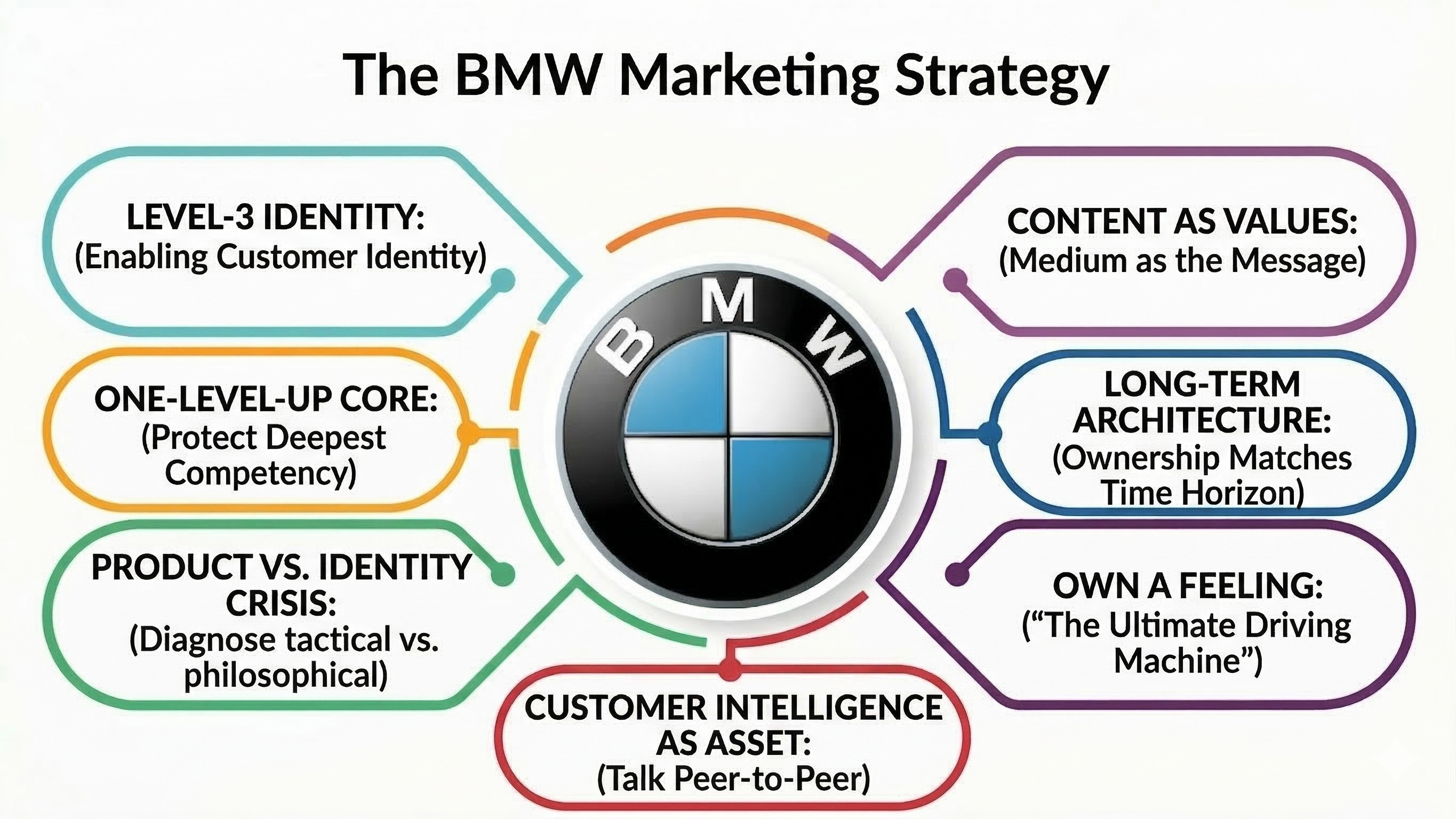
Here are seven principles extracted from BMW’s century of evidence that you can apply to your brand, business, or creative work starting today.
1. Find the Level-3 Identity Your Product Enables BMW doesn’t sell cars. It sells the identity of someone who values the drive. Ask yourself: what identity does your customer adopt by using your product or service? Not what they do, not how they feel - but who they become in their own story. When you can answer this clearly, your marketing writes itself.
2. Abstract Your Core Up One Level Before Pivoting BMW went from aircraft engines to motorcycles to cars by asking “what do we actually do at the deepest level?” The answer - precision engineering in service of human performance - survived every product category change. Before you pivot your business, ask: what is the one-level-up version of my core competency? That is the thing worth protecting. The specific product expression of it can change.
3. Make Your Content Demonstrate Your Values, Not Just Describe Them The Hire didn’t tell viewers BMW made great cars. It showed BMW’s entire aesthetic philosophy - taste, quality, intelligence, precision - through the medium of cinema. Your content should be evidence of your values, not a description of them. If you say you value quality, your free content should feel like premium work. The medium is the message.
4. Build Organizational Architecture That Matches Your Time Horizon The Quandt family’s long-term ownership is not a cultural accident - it is a structural decision that makes long-term thinking possible. Ask yourself: is your current business structure capable of the long-term vision you claim to have? Quarterly incentives produce quarterly decisions. If you want to build something that lasts decades, the way you own it, fund it, and govern it matters as much as the product itself.
5. Own a Feeling, Then Defend It “The Ultimate Driving Machine” is not a description. It is a claim of ownership over a specific feeling - the joy of being in command of a performance vehicle. Whatever feeling your brand owns, defend it in every decision. Product extensions, partnerships, pricing, customer service - every touch point either reinforces or erodes the feeling you own. BMW has never let a partnership, feature, or campaign contradict the core feeling. Neither should you.
6. Treat Your Customer’s Intelligence as an Asset, Not a Liability BMW Films was created because BMW knew their customer was sophisticated enough to want actual cinema, not commercials with cinematic production value. Most brands talk down to their audience. BMW talked across to theirs - peer to peer, not brand to consumer. The highest-performing brands in any premium category do the same thing. When you design a product or content experience, ask: does this treat my customer as someone intelligent and discerning, or as someone who needs to be managed?
7. Know the Difference Between a Crisis of Product and a Crisis of Identity BMW’s 1959 near-bankruptcy was a crisis of product. Their identity - precision engineering in service of the driver - was intact. That distinction matters enormously. When problems arise in your business, diagnose correctly: is this a product problem, a market problem, or an identity problem? Product and market problems have tactical solutions. Identity problems require philosophical ones. Most founders try to solve identity problems with marketing tactics. That is why most brands eventually disappear.
The businesses that outlast their founders, their categories, and sometimes their entire industries are the ones that figured out - usually through pain - what they actually are at the deepest level.
BMW figured it out when the Treaty of Versailles took away their only product.
You don’t need a global crisis to ask the same question.
Who are you, really? And what are you building that couldn’t be anything else?
Sit with that. The answer is worth more than any tactic in this letter.
-- Dennis

Nicely written, it kept me engaged till the end.
I love they fact then drew back to their essence and built based on that 💙